
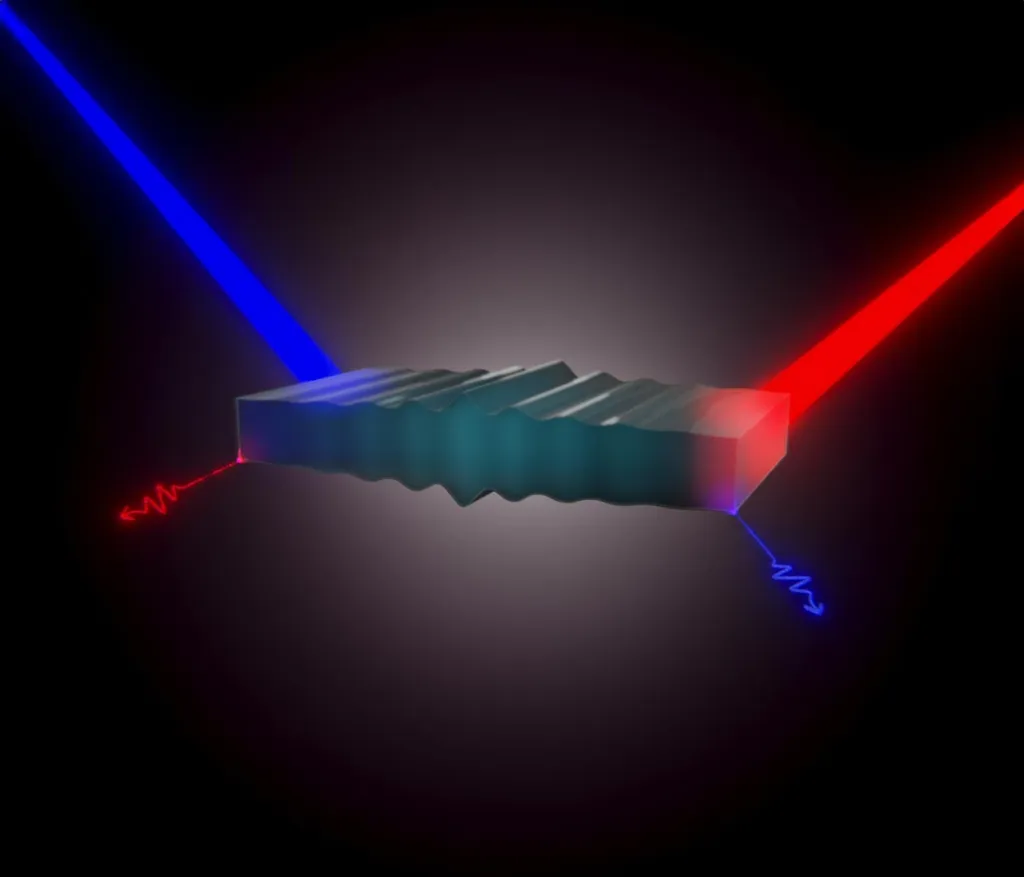
In the realm of energy research, a team of scientists from the Chinese Academy of Sciences and the University of Science and Technology of China has made a significant stride in understanding the behavior of particles in periodic structures, which could have implications for energy transport and storage systems. The researchers, Ren Zhang, Xiao-Yu Ouyang, Xu-Dong Dai, and Xi Dai, have developed a new method to study how particles scatter in one-dimensional, time-dependent lattices, a concept that could be harnessed to improve the efficiency of energy transfer in various applications.
The team has introduced a novel approach called the Floquet transfer matrix method to solve scattering problems in these dynamic lattices. This method reveals an underlying structure that ensures the conservation of current across different energy bands, or “sidebands,” in the system. By carefully designing the boundaries of the lattice, the researchers were able to minimize interference between these sidebands, allowing them to establish a direct relationship between a topological property of the lattice, known as the bulk winding number, and a shift in the energy windows where particles can transmit through the system. This shift is quantified as Cħω, where C is the bulk winding number, ħ is the reduced Planck constant, and ω is the frequency of the time-dependent modulation.
To validate their theoretical findings, the researchers proposed two experimental setups. The first involves using cold atoms and Bragg scattering to directly observe the predicted shift in the transmission energy windows. The second experiment suggests using surface-acoustic waves to induce transport in the lattice and demonstrate the existence of a quantized zero-bias current plateau, which is a direct consequence of the topological properties of the system.
The practical applications of this research for the energy sector are manifold. Understanding and controlling the scattering of particles in dynamic lattices can lead to more efficient energy transfer and storage systems. For instance, this research could inspire the development of novel materials or devices that can better harness and distribute energy in renewable energy systems, such as solar cells or wind turbines. Additionally, the insights gained from this study could contribute to the advancement of quantum technologies, which hold promise for ultra-efficient energy solutions.
This research was published in the journal Physical Review Letters, a prestigious publication in the field of physics. The findings represent a significant step forward in the understanding of particle dynamics in time-dependent lattices, paving the way for innovative energy technologies that could shape the future of the energy industry.
This article is based on research available at arXiv.