
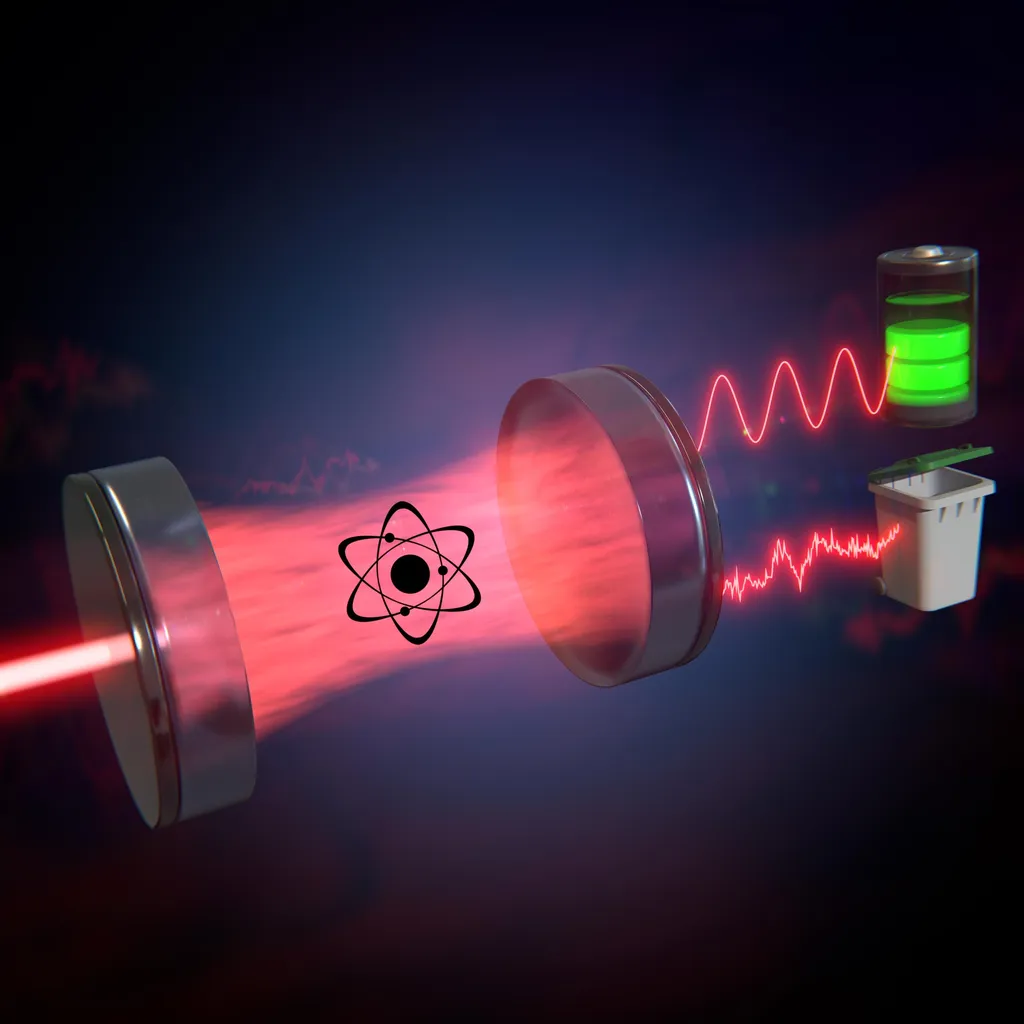
Researchers Yang Li and Fu-Lin Zhang from the University of Oxford have published a study in the journal Physical Review Letters that explores the thermodynamic uncertainty relation (TUR) in quantum thermal machines. The TUR is a fundamental constraint that links current fluctuations and entropy production, offering a refined interpretation of the second law of thermodynamics for small-scale systems. Understanding and manipulating this relationship is crucial for improving the performance of quantum technologies.
In their work, Li and Zhang examine a class of quantum thermal machine models that operate through coherent coupling between two energy levels, forming what they term a “virtual qubit.” This coupling enables steady-state coherences within this virtual-qubit subspace, which are essential for the system’s functionality. Without this coherent coupling, the system would satisfy detailed balance with the thermal reservoirs and would not support steady-state heat currents.
The researchers demonstrate that the steady-state currents and entropy production in these systems can be effectively reproduced by an classical Markov process. However, current fluctuations acquire an additional quantum correction due to coherence. This leads to a decomposition of the thermodynamic uncertainty into two parts: a classical (diagonal) contribution and a coherent contribution. Notably, the coherent contribution can become negative under resonant conditions and reaches its minimum at the coupling strength that maximizes steady-state coherence.
Li and Zhang also identify the conditions under which the thermodynamic uncertainty can be minimized and the criteria for surpassing the classical TUR bound, particularly in the vicinity of the reversible limit. Their findings provide valuable insights into the quantum thermodynamic effects that are essential for optimizing the performance of quantum technologies, which could have practical applications in the development of more efficient and advanced energy systems.
The research was published in the journal Physical Review Letters, a prestigious publication known for its high-impact research in the field of physics.
This article is based on research available at arXiv.