
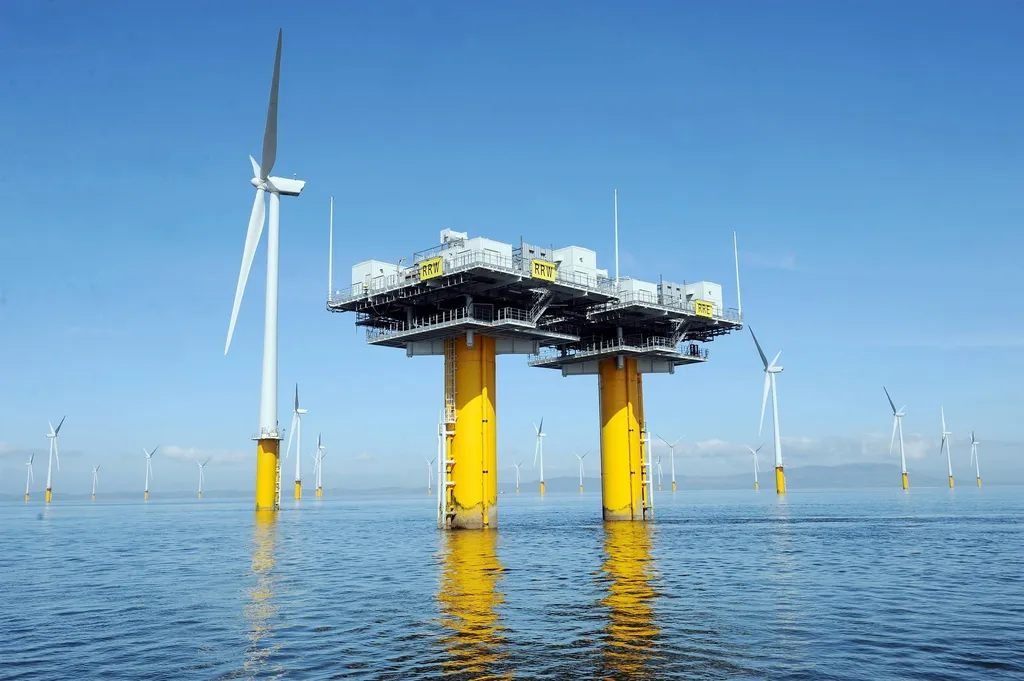
In the quest for accurate and efficient offshore wind power forecasting, a team of researchers from the University of Oxford, including Dominic Weisser, Chloé Hashimoto-Cullen, and Benjamin Guedj, has developed a novel approach that leverages transfer learning and meteorological clustering. Their work, published in the journal Nature Energy, addresses a critical challenge in the offshore wind industry: the need for accurate power forecasts from the outset of a new wind farm’s operation.
The researchers propose a framework that clusters power output based on meteorological features, rather than training a single, general-purpose model. This approach involves creating an ensemble of expert models, each trained on a specific cluster of weather patterns. By doing so, the models can adapt more efficiently to new sites and capture climate-dependent dynamics. This method significantly reduces the need for extensive site-specific data, which is often a limiting factor for new offshore wind farms.
The team evaluated their framework on eight offshore wind farms, achieving accurate cross-domain forecasting with as little as five months of site-specific data. The mean absolute error (MAE) of their experiments was 3.52%, demonstrating that reliable forecasts do not require a full annual cycle of local measurements. This finding is particularly valuable for the energy industry, as it allows for better grid stability, improved reserve management, and more efficient energy trading from the early stages of a wind farm’s operation.
Beyond power forecasting, this climate-aware transfer learning method opens new opportunities for offshore wind applications. One such application is early-stage wind resource assessment, where reducing data requirements can accelerate project development and mitigate risks. By providing more accurate and timely forecasts, this research contributes to the broader goal of decarbonization and the growth of renewable energy sources.
The researchers’ work was published in Nature Energy, a peer-reviewed journal that focuses on energy-related research and its impact on society. Their findings offer practical applications for the energy sector, particularly in the realm of offshore wind power forecasting and resource assessment. As the world continues to shift towards renewable energy sources, innovative approaches like this one will be crucial in ensuring the efficient and reliable operation of wind farms.
This article is based on research available at arXiv.