
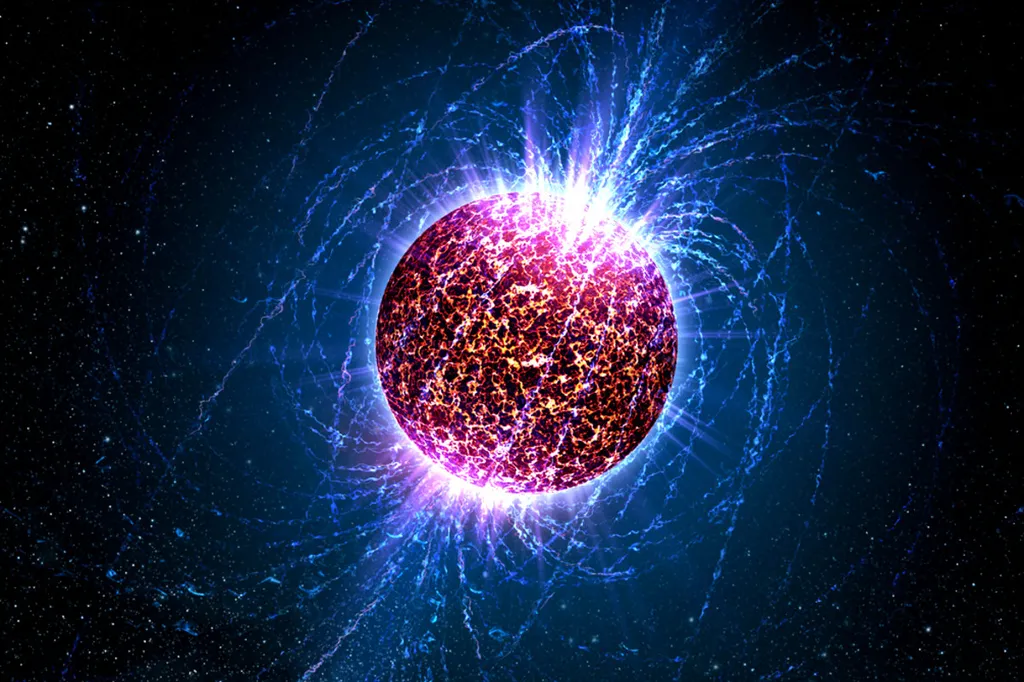
In the realm of astrophysics and energy research, a team of scientists from the Indian Institute of Technology Roorkee has been delving into the intriguing world of neutron stars and their unique properties. Researchers Manisha Kumari, Sujan Kumar Roy, Soumen Podder, Suman Pal, and Gargi Chaudhuri have published their findings in the journal Physical Review D, shedding light on the impact of antikaon condensates on the radial oscillation properties of neutron stars.
Neutron stars, the remnants of massive stars that have exploded as supernovae, are among the densest objects in the universe. Their study provides valuable insights into the behavior of matter under extreme conditions, which can have implications for understanding the fundamental forces and particles that govern our universe. The team’s research focuses on the radial oscillations of neutron stars, which are vibrations that occur within the star and are sensitive to the equation of state (EOS) of dense matter—the relationship between pressure and energy density.
The researchers employed two frameworks to model neutron star matter: non-linear and density-dependent relativistic mean-field frameworks. These models allowed them to explore a wide range of EOS stiffness, consistent with current astrophysical constraints. They then considered the emergence of antikaon condensates (specifically, K- and K̄⁰ particles) in the stellar core, which alters the pressure-energy density relation of the matter.
The study found that the transition from nuclear matter to the condensed phase is highly sensitive to the antikaon optical potential depth. By computing the fundamental and higher-order radial oscillation modes for neutron stars containing antikaon condensates, the team discovered that the antikaon optical potential depth plays a crucial role in governing the shifts observed in the radial oscillation frequencies. Moreover, it significantly reduces the stability limits and maximum masses of neutron stars.
These findings are particularly exciting for the energy sector, as they provide a promising avenue for future multi-messenger observations and high-frequency gravitational-wave searches. By probing the internal composition and EOS of neutron stars, scientists can gain a deeper understanding of the fundamental forces and particles that shape our universe. This knowledge can potentially lead to advancements in energy research, particularly in areas such as nuclear physics and astrophysics, which are closely tied to the development of new energy technologies.
In summary, the research conducted by Manisha Kumari and her colleagues offers valuable insights into the behavior of neutron stars and the impact of antikaon condensates on their radial oscillation properties. Their findings not only contribute to our understanding of the universe but also hold potential implications for the energy sector, driving innovation and discovery in the field of energy research.
This article is based on research available at arXiv.