
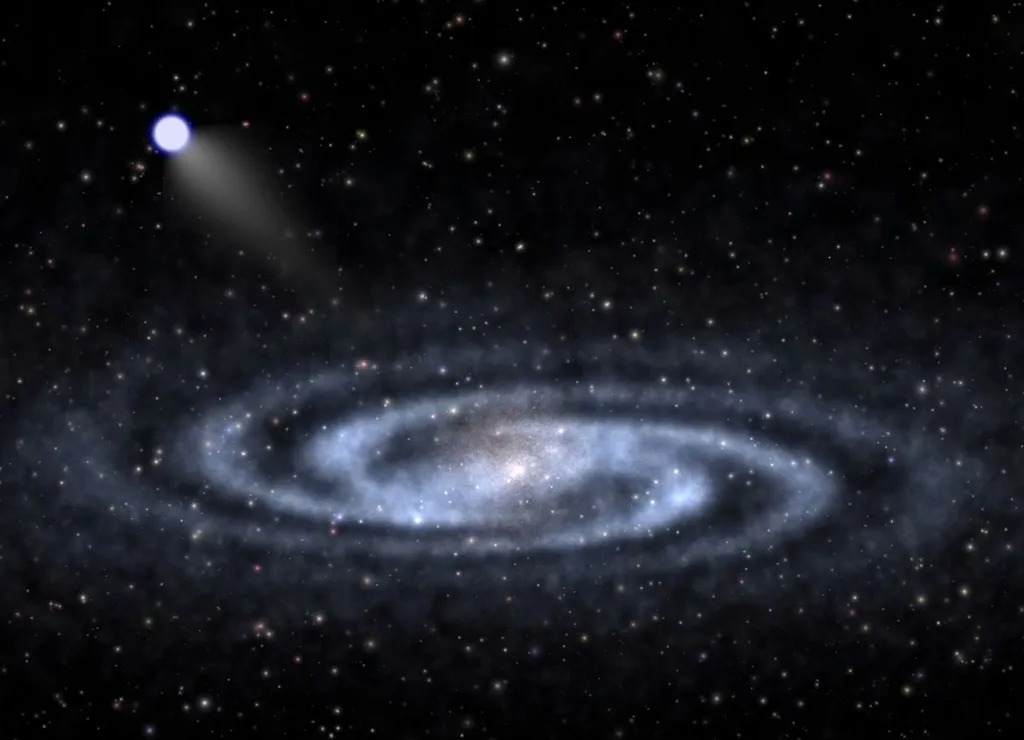
In a recent study, a team of astronomers led by Manuel Cavieres from the University of Cambridge, along with Sergey E. Koposov from the University of Edinburgh, Elena Maria Rossi from Leiden University, Zephyr Penoyre from University College London, and Sill Verberne from the University of Cambridge, has identified a new hypervelocity star (HVS) ejected from the center of our Milky Way galaxy. Their findings were published in the journal Astronomy & Astrophysics.
Hypervelocity stars are rare celestial objects that have been ejected from the Galactic Centre (GC) due to interactions with the supermassive black hole, Sagittarius A*. These stars are traveling at such high speeds that they can escape the gravitational pull of the GC and are observable in the galactic halo. The researchers used data from the Dark Energy Spectroscopic Instrument (DESI) and the Gaia mission to conduct a six-dimensional search for HVSs. Their search led to the discovery of a compelling candidate, named DESI-312, whose trajectory can be traced back to the GC.
DESI-312 is located in the inner halo of the Milky Way and exhibits a higher-than-average metallicity, which is a measure of the abundance of elements heavier than hydrogen and helium. This metallicity is distinct from other known stellar populations with similar orbits. The star’s inferred ejection velocity from the GC is consistent with a mechanism known as the Hills mechanism, which involves the tidal interaction of a binary star system with the supermassive black hole. This supports the idea that DESI-312 originated in the innermost regions of the Milky Way.
The researchers considered alternative origins for DESI-312, such as ejections from young clusters or globular clusters, but these scenarios could not explain both its orbit and metallicity. Unlike previously identified HVSs, DESI-312 is a lower-mass star, around the mass of our Sun, and is either on the main sequence or early subgiant branch. This makes it an excellent candidate for detailed chemical analysis, offering a rare, unobscured view into the composition of the central regions of the Galaxy.
While this research does not have direct practical applications for the energy industry, it contributes to our understanding of the dynamics and composition of our galaxy. This knowledge can indirectly support the development of space-based energy technologies and infrastructure by providing a better understanding of the space environment. Additionally, the advanced spectroscopic and astrometric techniques used in this study can potentially be adapted for monitoring and maintaining space-based energy systems.
This article is based on research available at arXiv.