
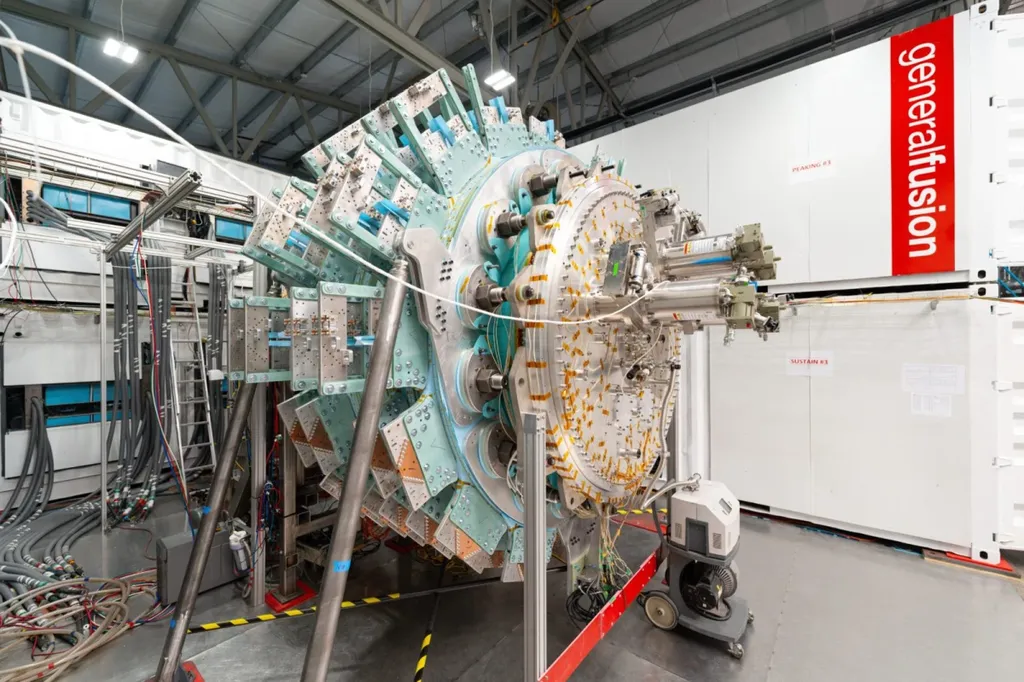
Carl Dunlea, a researcher at General Fusion, has been conducting experiments and simulations to advance the understanding of plasma physics relevant to magnetic target fusion compression. His work focuses on the magnetic compression of compact tori (CTs), which are doughnut-shaped plasma structures that could potentially be used to generate fusion energy.
In a recent study, Dunlea and his team at General Fusion performed repetitive, non-destructive tests to investigate the behavior of CTs under magnetic compression. The experiments involved forming a CT using a co-axial gun in a containment region with an hour-glass shaped inner flux conserver and an insulating outer wall. External coil currents were used to levitate the CT radially and then rapidly compress it inwards. The researchers found that optimizing the external coil configuration significantly improved both the levitated CT lifetime and the recurrence rate of shots with good compressional flux conservation.
The improved levitation field profile also reduced plasma impurity levels by minimizing the interaction between the plasma and the insulating outer wall during the formation process. This was confirmed by spectrometer data. The team observed significant increases in magnetic field, electron density, and ion temperature at magnetic compression in the final external coil configuration tested, despite the presence of an instability thought to be an external kink mode during compression.
To better understand the underlying physics, Dunlea developed the DELiTE (Differential Equations on Linear Triangular Elements) framework for spatial discretization of partial differential equations on an unstructured triangular grid in axisymmetric geometry. This framework is based on discrete differential operators in matrix form, derived using linear finite elements, and mimics some properties of their continuous counterparts. A single-fluid two-temperature magnetohydrodynamic (MHD) model was implemented in this framework to simulate the behavior of the CTs under magnetic compression.
The research conducted by Dunlea and his team at General Fusion provides valuable insights into the plasma physics of magnetic target fusion compression. These findings could potentially contribute to the development of more efficient and effective fusion energy systems. The study was published in the journal [Fusion Engineering and Design](https://www.sciencedirect.com/science/article/abs/pii/S092037962100006X).
This article is based on research available at arXiv.