
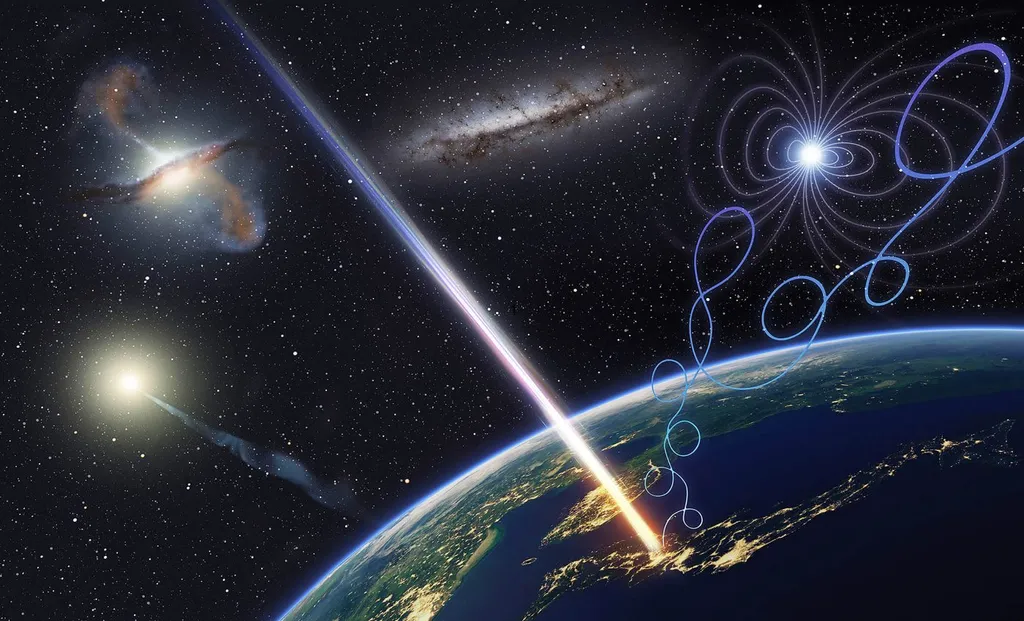
In the realm of energy journalism, a recent review paper has shed light on an unconventional yet promising tool for Earth observation: cosmic rays. These high-energy particles, originating from space and our atmosphere, have traditionally been the domain of particle physicists and astrophysicists. However, over the past two decades, they have found new applications in observing and understanding Earth’s systems.
The researchers behind this review, Bugra Bilin and Nuhcan Akçit, are affiliated with the Istanbul Technical University in Turkey. Their work compiles the use of cosmic rays in three primary areas: particle physics and atmospheric processes, geosciences, and urban science. The review was published in the journal “Surveys in Geophysics.”
In the first area, cosmic rays interact with the atmosphere, creating cascades of secondary particles and ionization. These processes can influence atmospheric chemistry and radiation, which in turn can impact air quality and climate. Understanding these interactions can help energy companies anticipate and mitigate potential impacts on their operations and infrastructure.
In the realm of geosciences, cosmic rays have proven valuable in dating geological materials using cosmogenic radionuclides. This can be particularly useful in the energy sector for understanding the age and history of potential drilling sites. Moreover, cosmic-ray neutrons are used for large-scale monitoring of soil moisture and snow water equivalents. This information can be crucial for energy companies involved in hydropower or those needing to manage water resources for their operations.
In urban science, cosmic-ray muons are employed for non-invasive subsurface imaging. This can be a game-changer for energy companies, allowing them to map underground infrastructure, detect potential hazards, or plan new construction without disruptive and costly digging. When paired with distributed sensors, these muons can also serve as the basis for smart city monitoring, helping energy companies optimize their services and infrastructure in urban areas.
The review emphasizes the integration of these cosmic-ray methods with remote sensing and geographic information systems (GIS). This integration can help bridge the persistent scale gap between point measurements and satellite observations, enabling three-dimensional digital representations of subsurfaces. This can provide energy companies with more comprehensive and accurate data for decision-making.
The review also discusses data standards and their integration into operational Earth observation workflows, as well as future research directions. As our understanding of cosmic rays and their applications continues to evolve, so too will their potential benefits for the energy sector.
This article is based on research available at arXiv.