
In the realm of energy-efficient cooling technologies, a team of researchers from the University of Colorado Boulder has made a significant stride. The team, led by Dr. Xuguang Zhang and including Hexiang Zhang, Hanqing Liu, Xiaoli Li, Mu Ying, Yutian Yang, Marilyn L. Minus, Ming Su, and Yi Zheng, has developed a novel passive daytime radiative cooling (PDRC) system that could have practical applications in the energy sector. Their work was recently published in the journal Nature Sustainability.
Passive daytime radiative cooling is a process that cools surfaces by reflecting sunlight and emitting heat as infrared radiation. The researchers have created a new type of PDRC system that can be applied to flexible, curved, or wearable surfaces, unlike many existing systems that are limited to rigid or planar substrates. This advancement opens up new possibilities for energy-efficient cooling in various industries, including energy production and storage.
The researchers developed a biocompatible and structurally robust PDRC system integrated onto a commercial rapid-curing fiberglass cast, a conformal substrate widely used in orthopedic and industrial applications. The cooling architecture adopts a bilayer polymer design consisting of a polyvinyl alcohol (PVA) adhesion layer and a polymethyl methacrylate (PMMA) protective layer, both embedded with calcium pyrophosphate (CPP) ceramic particles derived from processed animal bone waste. This bio-derived CPP simultaneously enables broadband solar scattering and high mid-infrared emittance, while offering sustainability and biocompatibility advantages.
The resulting composite exhibits over 90% solar reflectance and achieves up to 15°C sub-ambient cooling under direct outdoor sunlight. This means that the system can cool surfaces below the ambient temperature, even under direct sunlight, without consuming any energy. This could lead to significant energy savings in applications such as building cooling, solar panel efficiency enhancement, and even personal cooling in hot environments.
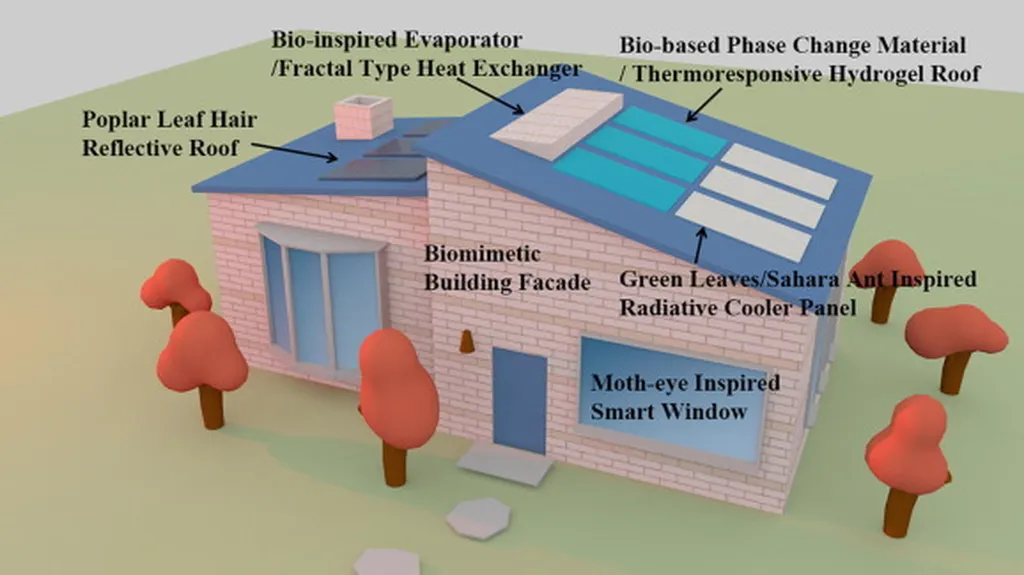
The practical applications of this research in the energy sector are manifold. For instance, integrating this PDRC system into solar panels could enhance their efficiency by keeping them cool, as solar panels generate less electricity when they are hot. Similarly, applying this technology to buildings could reduce the need for energy-intensive air conditioning, leading to significant energy savings. Moreover, the use of bio-derived materials makes this technology more sustainable and environmentally friendly.
In conclusion, the research team from the University of Colorado Boulder has developed a novel PDRC system that could have significant implications for the energy sector. By enabling energy-free cooling on flexible and curved surfaces, this technology could enhance the efficiency of solar panels, reduce the energy consumption of buildings, and contribute to a more sustainable future. The research was published in the journal Nature Sustainability, a testament to its scientific rigor and potential impact.
This article is based on research available at arXiv.