
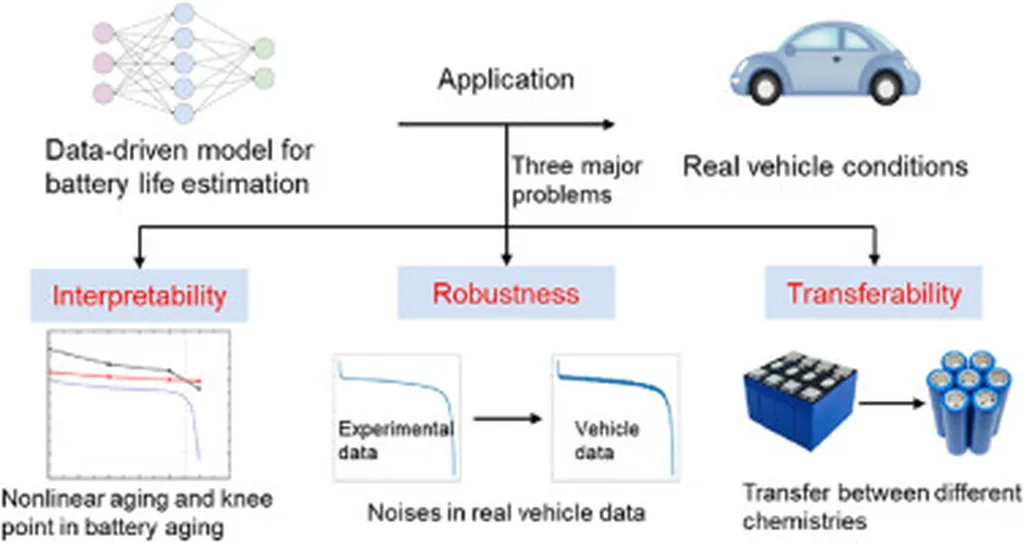
Researchers from the University of Warwick, including Lucu M., Martinez-Laserna E., Gandiaga I., Liu K., Camblong H., Widanage W. D., and Marco J., have developed a new data-driven approach to modeling lithium-ion battery ageing. Their work, published in the Journal of Energy Storage, aims to leverage real-world operational data to improve the accuracy of battery ageing predictions, reducing the need for extensive laboratory testing.
Traditional lithium-ion battery ageing models, such as electrochemical, semi-empirical, and empirical models, require significant time and resources to provide accurate predictions under realistic operating conditions. However, with the increasing adoption of telemetry technology in the energy industry, a wealth of real-world battery operation data is becoming available. This presents an opportunity to develop ageing models that can learn from this in-field data, mitigating the need for exhaustive laboratory testing.
The researchers developed a data-driven ageing model for lithium-ion batteries using the Gaussian Process framework. This model is designed to learn from new data observations, providing more accurate and confident predictions and extending the operating window of the model. The first part of their two-part study focuses on the systematic modeling and experimental verification of cell degradation through calendar ageing.
The team composed a specific covariance function tailored for use in a battery ageing application. They tested the model on an extensive dataset involving 32 cells over more than three years, exploring different training possibilities to quantify the minimal number of laboratory tests required for an accurate ageing model. The results showed that a model trained with only 18 tested cells achieved an overall mean-absolute-error of 0.53% in the capacity curves prediction. This was validated under a broad window of both dynamic and static temperature and state of charge (SOC) storage conditions.
For the energy industry, this research offers a promising approach to improving battery management systems. By leveraging real-world operational data, energy companies can enhance the accuracy of their battery ageing predictions, leading to better maintenance scheduling, improved safety, and extended battery life. This can have significant implications for various applications, including electric vehicles, renewable energy storage, and grid stabilization.
The practical applications of this research are vast. For instance, in the renewable energy sector, accurate battery ageing models can help optimize the performance and lifespan of energy storage systems, ensuring a more reliable and efficient integration of renewable energy sources into the grid. Similarly, in the electric vehicle industry, better battery management can lead to improved vehicle performance and range, as well as reduced maintenance costs.
In conclusion, the researchers have demonstrated a novel approach to lithium-ion battery ageing modeling that leverages real-world operational data. This method has the potential to significantly reduce the need for extensive laboratory testing while improving the accuracy of ageing predictions. As the energy industry continues to adopt telemetry technology, such data-driven models will become increasingly valuable for optimizing battery performance and lifespan.
Source: Journal of Energy Storage, Volume 39, September 2021, 102737
This article is based on research available at arXiv.