
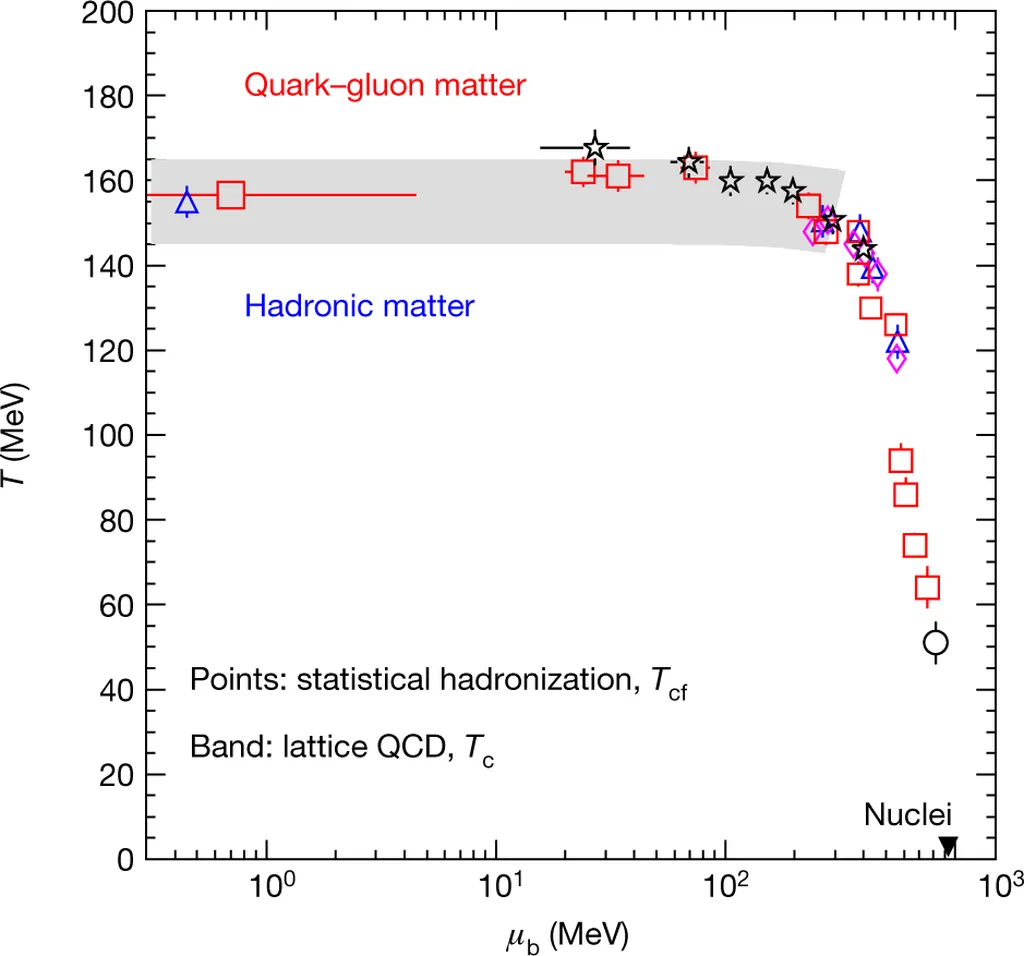
In the realm of high-energy physics, a trio of researchers—Peter Braun-Munzinger from the GSI Helmholtz Centre for Heavy Ion Research in Germany, Anar Rustamov from the Azerbaijan National Academy of Sciences, and Nu Xu from the University of Science and Technology of China—have been delving into the intricacies of the strong interaction, governed by Quantum Chromodynamics (QCD). Their work, published in the journal Nature Reviews Physics, explores the phase structure of QCD, shedding light on the fundamental processes that shaped the early universe.
The strong interaction is one of the four fundamental forces of nature, and it is responsible for binding quarks and gluons together to form protons, neutrons, and other hadrons. In the early universe, about 10 microseconds after the Big Bang, the primordial matter existed as a hot, dense soup of quarks, gluons, and other particles known as the quark-gluon plasma (QGP). As the universe cooled, this plasma underwent a phase transition, giving rise to the protons and neutrons that make up ordinary matter today.
The researchers’ review focuses on recent breakthroughs in understanding the QCD phase diagram, which maps out the different phases of matter under varying conditions of temperature and density. They highlight measurements of particle production and fluctuations, comparing them to theoretical predictions to gain insights into the nature of the QCD phase transition.
One of the key aspects of their work is the study of fluctuations and correlations in particle production. These measurements provide valuable information about the critical point—a specific condition in the QCD phase diagram where the transition between different phases becomes continuous. Identifying the critical point is crucial for understanding the behavior of matter under extreme conditions, such as those found in the early universe or in the cores of neutron stars.
The practical applications of this research for the energy sector are not immediately apparent, as the work is fundamentally focused on understanding the basic building blocks of the universe. However, a deeper understanding of the strong interaction and the behavior of matter under extreme conditions can have indirect implications for various fields, including nuclear energy and plasma physics. For instance, insights into the behavior of quark-gluon plasma could inform the development of more efficient and sustainable nuclear fusion reactors, which aim to harness the power of the same fundamental forces that govern the behavior of matter in the early universe.
In summary, the work of Braun-Munzinger, Rustamov, and Xu represents a significant step forward in our understanding of the QCD phase structure. Their review highlights the importance of fluctuations and correlations in particle production and provides a roadmap for future experimental opportunities in high-energy nuclear collisions. While the direct applications to the energy sector may be limited, the fundamental insights gained from this research could pave the way for advancements in nuclear energy and plasma physics.
This article is based on research available at arXiv.