
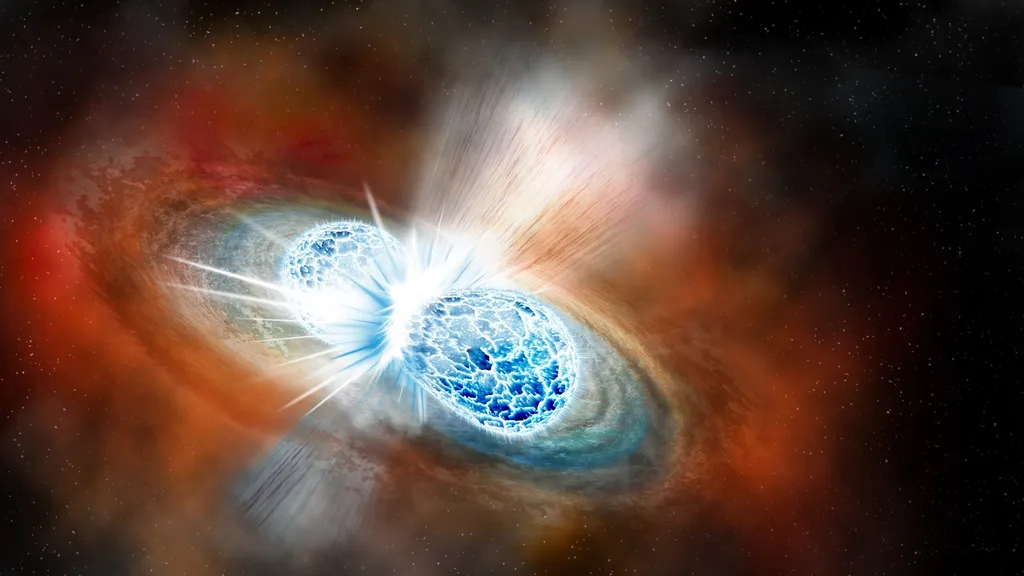
In the realm of energy and astrophysics, a team of researchers from the University of Lyon, including H. Güven, K. Bozkurt, E. Khan, and J. Margueron, has delved into the intricate properties of compact stars, shedding light on the role of symmetry energy in these celestial bodies. Their work, recently published in the journal Physical Review C, offers insights that could potentially influence our understanding of neutron stars and hybrid stars, which may have implications for energy research and nuclear physics.
The study focuses on the impact of symmetry energy, a component of the nuclear equation of state, on the properties of compact stars. These stars can exist as neutron stars, composed solely of nuclear matter, or as hybrid stars, which possess a core of quark matter. The researchers considered two typical models for the nuclear equation of state: soft and stiff. For hybrid stars, they employed a parameterized first-order phase transition approach, coupled with a linear quark matter equation of state.
One of the key findings of this research is that the phase transition from nuclear matter to quark matter reduces the tension between observations from gravitational wave event GW170817 and those from the Neutron star Interior Composition Explorer (NICER). This suggests that hybrid stars with a quark core can better reconcile these different sets of observations. The study also illustrates how the symmetry energy plays a crucial role in understanding the nature of the binary system involved in GW170817.
Moreover, the researchers confirmed their previous findings that the gravitational wave signal from GW170817 is best described as originating from a binary system of hybrid stars with a low-density onset of stiff quark matter. This could also be interpreted as a quarkyonic cross-over, a theoretical concept that blends aspects of nuclear and quark matter.
For the energy sector, this research contributes to the broader understanding of nuclear matter under extreme conditions, which can inform the development of advanced nuclear energy technologies. The insights gained from studying compact stars can potentially lead to improvements in nuclear reactor designs and safety measures, as well as a deeper comprehension of the fundamental properties of matter.
This article is based on research available at arXiv.