
In the realm of energy journalism, it’s crucial to stay informed about advancements in scientific research that could potentially impact the energy sector. A recent study, led by David Chemaly from the University of Cambridge and involving researchers Elisabeth Sola, Vasily Belokurov, Sergey Koposov, GyuChul Meyong, HanYuan Zhang, and Denis Erkal, offers a novel approach to understanding dark matter halo shapes using stellar streams. This research, published in the journal Monthly Notices of the Royal Astronomical Society, presents a method that could enhance our understanding of dark matter distribution, a key factor in the structure and evolution of galaxies.
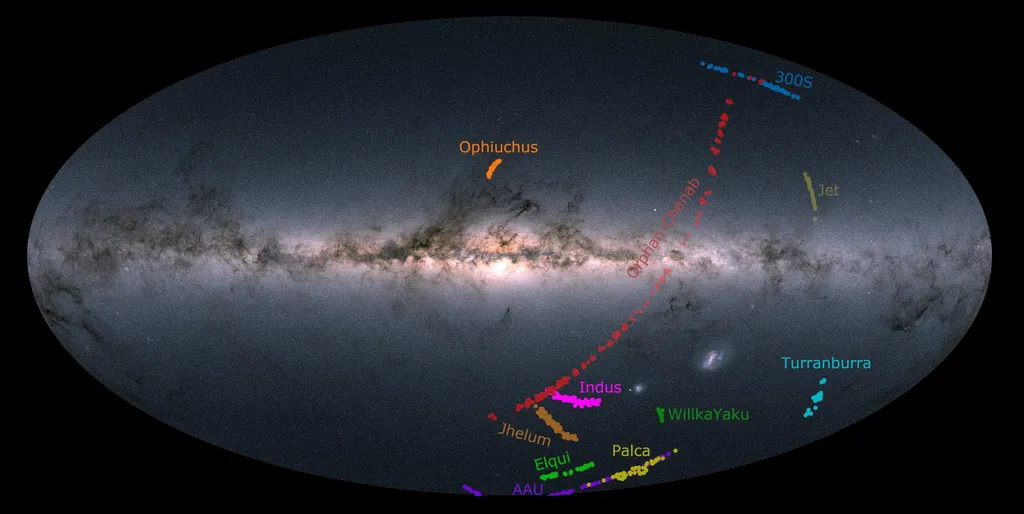
The researchers developed a hierarchical Bayesian framework that infers the population distribution of dark matter halo flattening using only projected stream tracks. Stellar streams, which are the remnants of tidally disrupted satellites, trace the gravitational potential of their host galaxies and thus provide insights into dark matter halo structure. While detailed phase-space data of Galactic streams enable precise dark matter halo modeling in the Milky Way, streams around external galaxies are typically available only as low surface brightness features without kinematics, offering weak constraints when considered individually.
To address this challenge, the team created a new particle-spray package called StreaMAX, which is accelerated by JAX and achieves significantly faster stream generation compared to traditional methods. For each stream, they fitted an axisymmetric dark matter halo model and obtained a posterior on the flattening. These posteriors were then combined through hierarchical reweighting to constrain the population distribution. Using mock data, the researchers demonstrated that individual fits could recover the correct flattening with modest precision, although they exhibited projection-induced multi-modalities. However, aggregating these fits yielded accurate and confident constraints on the underlying population distribution of dark matter halo morphologies, distinguishing between oblate, spherical, and prolate populations.
The computational cost of this method scales linearly with sample size, making it efficient for large datasets. With the forthcoming samples from Euclid and Rubin/LSST, this approach offers a practical way to make population-level inferences of halo morphology without any kinematic measurements. This research highlights the potential of leveraging photometric data to understand dark matter distribution, which could have implications for the energy sector, particularly in areas such as dark matter detection and the development of advanced energy technologies that rely on a deep understanding of fundamental physics.
In summary, the study presents a novel hierarchical Bayesian framework that uses stellar streams to infer the population distribution of dark matter halo shapes. This method, combined with the upcoming data from large-scale surveys, provides a promising avenue for enhancing our knowledge of dark matter distribution, which could ultimately contribute to advancements in the energy industry.
This article is based on research available at arXiv.