
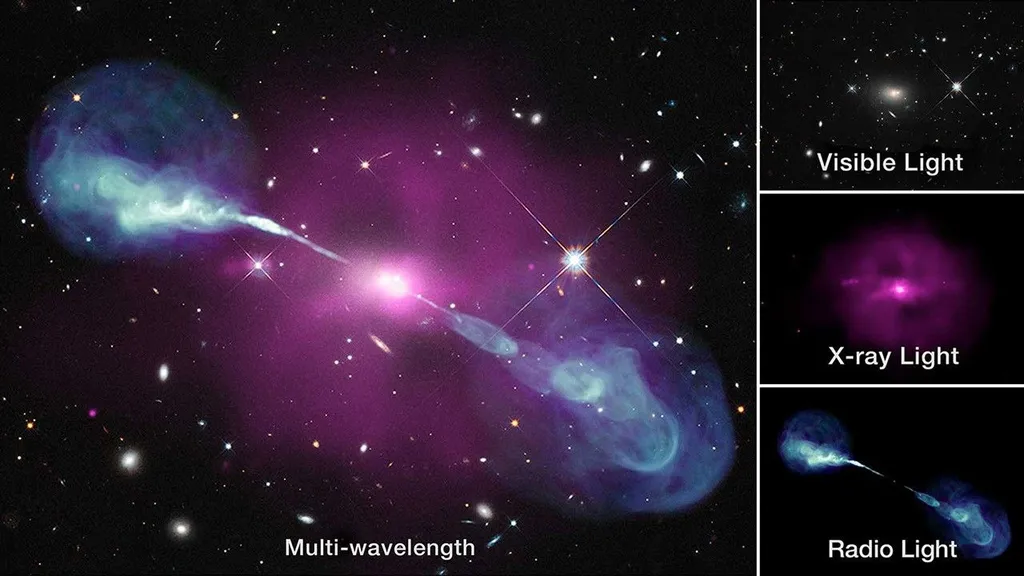
In a recent study led by Yuhan Wen and colleagues from The Kavli Institute for Astronomy and Astrophysics at Peking University, researchers have investigated the impact of active galactic nuclei (AGN) radio activity on the cold gas reservoirs in quasars. The team, which includes Ran Wang, Luis C. Ho, Jinyi Shangguan, Ezequiel Treister, Guodong Li, and Franz E. Bauer, published their findings in the Astrophysical Journal.
The researchers focused on quasars, which are extremely luminous active galactic nuclei, to understand how AGN radio activity influences the cold gas properties of their host galaxies. They constructed a sample of quasars with an average redshift of about 1.5 and an average bolometric luminosity of approximately 10^45.8 erg per second. All quasars in the sample were detected by the Herschel Space Observatory, allowing the team to estimate the total gas mass through the galactic dust continuum emission.
The quasar sample was divided into three groups based on their radio loudness: radio loud (RL) quasars, radio-detected radio quiet (RQ) quasars, and radio-undetected quasars. Through spectral energy distribution (SED) fitting, the researchers found that the radio-detected RQ quasars exhibited evidence of gas deficiency. Specifically, the host galaxies of these quasars possessed about 0.3 dex lower dust and gas masses compared to the other two groups, despite being matched in black hole mass, bolometric luminosity, stellar mass, and star formation rate.
Furthermore, the team analyzed optical spectra and found that both the fraction and velocity of outflows were higher in the radio-detected RQ group. This suggests a connection between the ionized gas outflows and the moderate radio activity in these quasars. The results imply that AGN feedback could be more efficient in AGNs with weak or moderate radio emission than in those without radio detection or those with strong radio emission.
For the energy sector, this research highlights the potential impact of AGN feedback on the evolution of galaxies and their cold gas reservoirs. Understanding these processes can provide insights into the regulation of star formation and the growth of supermassive black holes, which are crucial for modeling the energy output and evolution of galaxies. Further high-resolution observations are needed to better understand the interaction between the interstellar medium and weak/moderate AGN radio activity, which could have implications for energy production and distribution in the universe.
This article is based on research available at arXiv.