
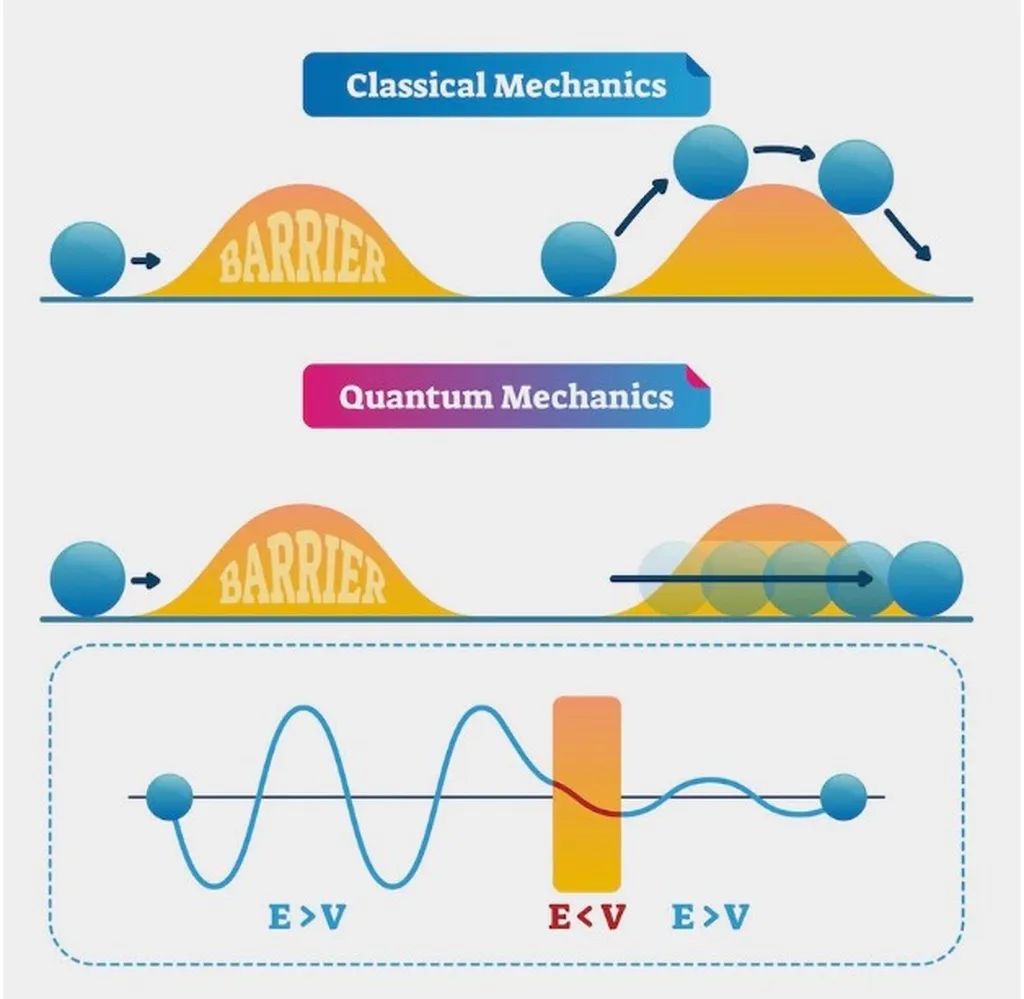
Researchers Bhaskar Pandit, Debabrata Sinha, and Satyaki Kar from the Indian Institute of Science Education and Research, Kolkata, have published a study in the journal Physical Review B that explores the behavior of electrical and thermal conductance through a unique type of junction involving a nodal surface semimetal (NSSM), an insulator, and a superconductor. Their work provides insights into the quantum tunneling processes within this heterostructure, which could have implications for the energy sector, particularly in the development of advanced materials for energy transport and management.
The researchers focused on a junction consisting of a nodal surface semimetal, an insulator, and an s-wave superconductor (NSSM-I-SC junction). They analyzed the quantum tunneling of electrons through this junction, examining both normal and Andreev conductance for different incident orientations and excitation energies relative to the superconducting gap potential. Their findings reveal that the electrical conductance (G) through the junction oscillates periodically with a frequency of π as a function of the barrier strength, both in high and low doping limits. This periodic behavior is also observed in the thermal conductance (κ) through the junction.
One of the novel aspects of this study is the comparison of the behavior of G and κ with the insulator width in the NSSM-I-SC junction to that in a normal metal-insulator-superconductor (NIS) junction on graphene or silicene. The researchers found significant differences, suggesting that the unique properties of NSSM could offer new avenues for controlling electric and thermal transport in topological materials.
The practical applications of this research for the energy sector include the potential development of more efficient and controllable materials for energy transport and management. By understanding and harnessing the unique properties of NSSM, researchers may be able to design materials that can more effectively conduct electricity and manage heat, leading to improvements in energy storage, transmission, and conversion technologies.
The study, titled “Electrical and Thermal conductance through a Nodal Surface Semimetal-Insulator-Superconductor junction,” was published in Physical Review B. The findings provide a theoretical foundation for future experimental work aimed at exploring and exploiting the unique properties of NSSM in energy-related applications.
This article is based on research available at arXiv.