
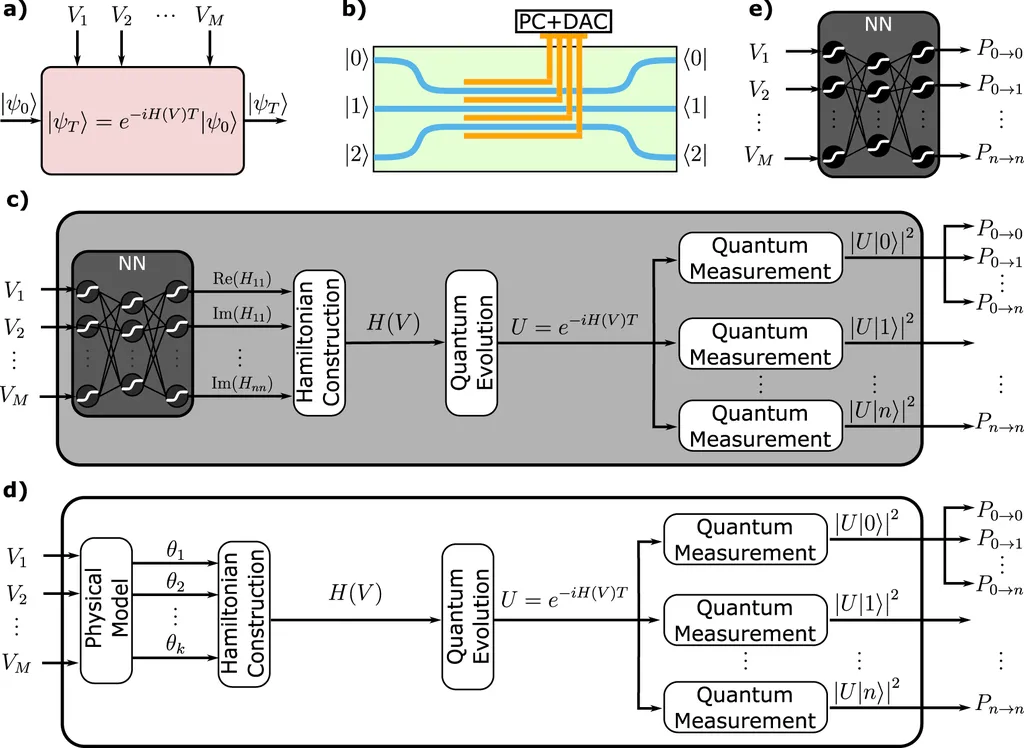
In the realm of quantum sensing, a team of researchers from the University of Technology Sydney and the University of Melbourne has made a significant stride. Akram Youssry, Stefan Todd, Patrick Murton, Muhammad Junaid Arshad, Alberto Peruzzo, and Cristian Bonato have developed a novel approach to improve the practical performance of quantum sensors. Their work, published in the journal Nature Communications, introduces a graybox modeling strategy that combines physics-based system models with data-driven descriptions of experimental imperfections.
Quantum sensors are renowned for their superior spatial resolution and sensitivity compared to classical devices. These attributes open up transformative applications across various fields, including materials science and healthcare. However, their practical performance is often hindered by unmodeled effects such as noise, imperfect state preparation, and non-ideal control fields. The researchers’ graybox framework aims to address these challenges by integrating a physics-based system model with a data-driven description of experimental imperfections.
The graybox approach offers a middle ground between purely analytical (whitebox) models and fully deep-learning models. It achieves higher fidelity than whitebox models while requiring fewer training resources than deep-learning models. The researchers validated their method by estimating a static magnetic field using a single-spin quantum sensor. They performed Bayesian inference with a graybox model trained on prior experimental data. The results were impressive, with the graybox model yielding several orders of magnitude improvement in mean squared error over the corresponding physics-only model.
The practical implications of this research are substantial. The graybox modeling strategy is broadly applicable to a wide range of quantum sensing platforms, not limited to single-spin systems. It is particularly valuable for real-time adaptive protocols, where model inaccuracies can otherwise lead to suboptimal control and degraded performance. In the energy sector, improved quantum sensors could enhance the precision of magnetic field measurements, which are crucial for various applications such as monitoring electrical currents, detecting faults in power systems, and improving the efficiency of energy storage systems.
In summary, the researchers have demonstrated a novel graybox modeling strategy that significantly improves the practical performance of quantum sensors. This approach has broad applicability and holds promise for advancing real-time adaptive protocols in various fields, including the energy sector. The research was published in the journal Nature Communications, providing a solid foundation for further exploration and development in quantum sensing technologies.
This article is based on research available at arXiv.