
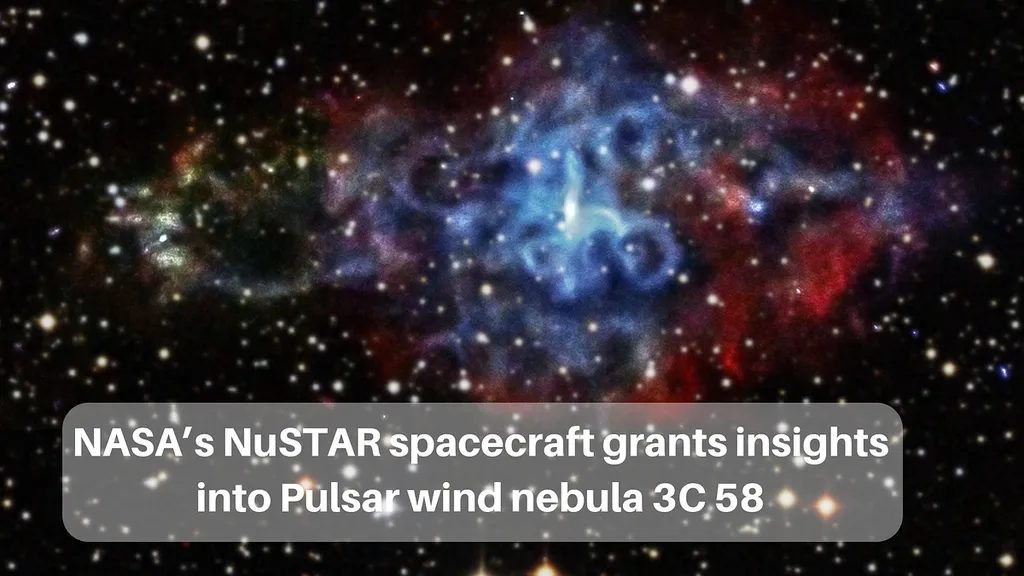
In a recent study, a team of researchers led by Pierrick Martin from the University of Strasbourg, along with colleagues from institutions in Italy and France, has uncovered new insights into the behavior of pulsar wind nebulae using the MeerKAT radio telescope. Their findings, published in the journal Astronomy & Astrophysics, shed light on how energetic particles escape from these nebulae and interact with the interstellar medium.
The Lighthouse Nebula, a type of bow-shock pulsar wind nebula, is known for its high-velocity pulsar and a long, misaligned X-ray jet. This nebula serves as a valuable source for studying the dynamics of relativistic pulsar winds and their conversion into cosmic-ray leptons at the highest energies. The researchers focused on GHz radio observations, which probe lower-energy particles that are numerous and long-lived, providing a long-term view of particle escape mechanisms.
Using 10.5 hours of MeerKAT observations in the 0.9-1.7GHz band, the team detected a highly structured synchrotron nebula downstream of the pulsar PSR J1101-6101. They observed a cometary tail extending beyond 5 parsecs from the pulsar and, for the first time, a system of multiple transverse two-sided emission streaks. Notably, no radio counterpart of the misaligned X-ray jet was seen.
The radio streaks are interpreted as the occasional release of energetic leptons from the tail into the surrounding medium, driven by dynamical instabilities and reconfiguration in the downstream flow. The intensity distribution suggests that most of the particle content of the nebula is discharged into the ambient medium within several parsecs. Once escaped, these particles illuminate the ambient magnetic field, which appears to have a coherence length of at least a few parsecs.
The length and persistence of the streaks indicate a low level of magnetic turbulence, possibly slightly enhanced compared to average cosmic-ray transport conditions in the Galaxy. This confinement could result from self-generated turbulence by resonant streaming instability or be due to past activity of the progenitor star.
For the energy sector, understanding the behavior of cosmic rays and their interaction with magnetic fields can have implications for space weather and the design of space-based infrastructure. Cosmic rays can affect the performance and longevity of satellites and other space-based energy systems, such as solar panels and communication equipment. Insights into the transport and confinement of cosmic rays can help in developing better protective measures and more resilient technologies for space-based energy applications.
In summary, this research provides a deeper understanding of the escape mechanisms of energetic particles from pulsar wind nebulae and their interaction with the interstellar medium. The findings contribute to our knowledge of cosmic-ray transport and have practical applications for the energy sector, particularly in space-based energy systems.
This article is based on research available at arXiv.