
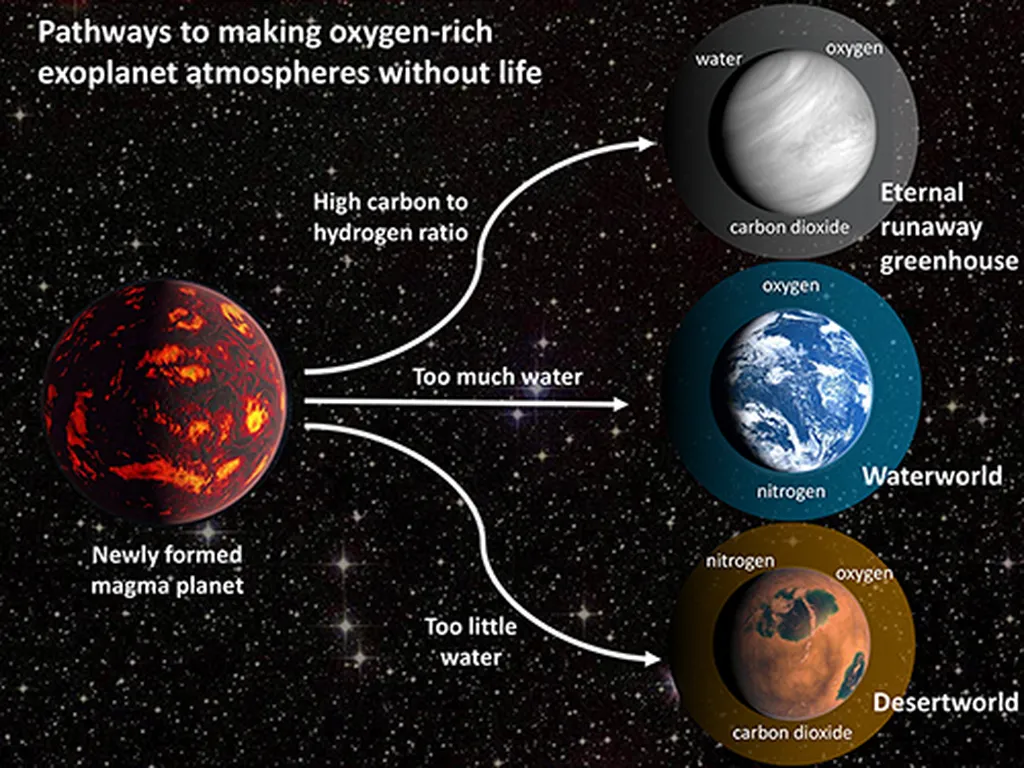
In the realm of astrobiology and energy research, a team of scientists from the Institut de Physique du Globe de Paris, led by Adam Y. Jaziri, has been exploring the potential for oxygen-rich atmospheres on exoplanets, particularly those orbiting M-dwarf stars. Their work, published in the journal Nature Astronomy, offers insights that could influence our understanding of planetary habitability and, by extension, the potential for life and energy production beyond our solar system.
The team focused on the Great Oxidation Event (GOE), a pivotal moment in Earth’s history when oxygen levels rose dramatically, paving the way for complex life. This event occurred around 2.4 billion years ago, long after the emergence of oxygen-producing photosynthesis. The researchers used a sophisticated model to simulate the atmospheric evolution of TRAPPIST-1 e, an Earth-like exoplanet orbiting an M-dwarf star, to understand how similar events might unfold on other planets.
Their findings suggest that the unique energy distribution of M-dwarf stars could facilitate the production of ozone (O3) at lower oxygen concentrations compared to Earth. This means that the threshold for atmospheric oxidation on planets like TRAPPIST-1 e might be lower, potentially leading to a quicker transition to an oxygen-rich atmosphere following the emergence of photosynthesis. In some scenarios, this transition could occur up to a billion years earlier than it did on Earth, accelerating the potential development of complex life.
From an energy perspective, understanding the atmospheric composition of exoplanets is crucial. Oxygen-rich atmospheres could indicate the presence of photosynthetic life, which is a potential source of bioenergy. Moreover, the detection of ozone, as suggested by this study, could serve as a biosignature, guiding future missions to identify habitable exoplanets and assess their potential for supporting life and energy production.
The researchers also highlight the practical implications for upcoming telescopic observations. The James Webb Space Telescope, for instance, could detect ozone in the atmospheres of exoplanets like TRAPPIST-1 e, providing valuable data for assessing their habitability. Previous studies estimated that detecting ozone in an Earth-like atmosphere would require over 150 transits, but this work suggests that significantly fewer transits could be needed, making the detection of oxygenation signatures more feasible.
In summary, this research offers a nuanced view of how atmospheric oxygenation might occur on exoplanets, with implications for the energy sector’s interest in astrobiology and the search for habitable worlds. As we continue to explore the cosmos, understanding these processes will be key to identifying potential sources of bioenergy and unraveling the mysteries of life beyond Earth.
This article is based on research available at arXiv.