
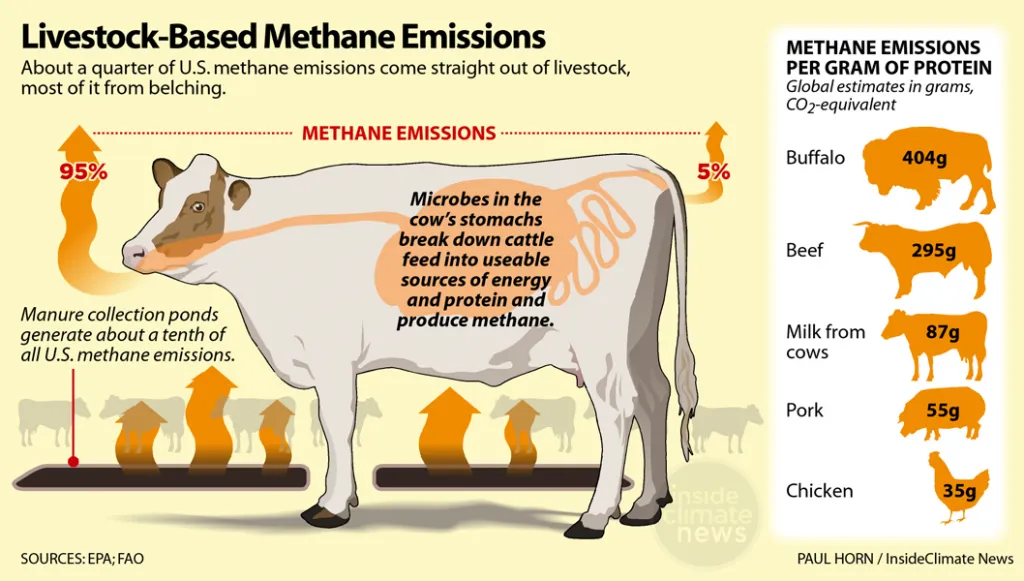
A team of researchers from various institutions, including Princeton University and the University of Toronto, has published a study that challenges the common perception of livestock’s impact on global warming. The researchers, led by David Alexander, have delved into the complex interplay between methane emissions from livestock and Earth’s temperature.
The study, published in the journal ‘Science of the Total Environment’, finds that methane emissions from livestock have a negligible effect on Earth’s temperature. To illustrate this point, the researchers presented a stark scenario: if all approximately 1.6 billion cattle on Earth were killed in the year 2025, the resulting reduction in atmospheric methane concentrations would only change the temperature by -0.04°C. Similarly, eliminating all 1.3 billion sheep would lead to an even smaller temperature change of -0.004°C.
The researchers also examined New Zealand’s pledge to reduce methane emissions from livestock by 14% to 24% from 2017 levels. They found that this reduction would result in an almost immeasurable temperature change of -0.000005 to -0.000008°C. These figures represent the maximum potential temperature savings, assuming that methane emissions from domestic livestock are not replaced by other sources, such as wild ruminants and termites, during the rewilding of managed grasslands and rangelands.
The study’s findings have significant implications for the energy industry, particularly for companies involved in livestock farming and agricultural practices. The research suggests that efforts to reduce methane emissions from livestock may have a minimal impact on global temperatures. Therefore, resources might be better allocated to other strategies for mitigating climate change, such as reducing carbon dioxide emissions or investing in renewable energy sources.
In conclusion, the study by Alexander and his colleagues provides a nuanced perspective on the role of livestock methane emissions in global warming. While the findings may not align with popular narratives, they contribute valuable insights to the ongoing debate about effective climate change mitigation strategies. For the energy industry, this research underscores the importance of a balanced and evidence-based approach to addressing environmental challenges.
This article is based on research available at arXiv.