
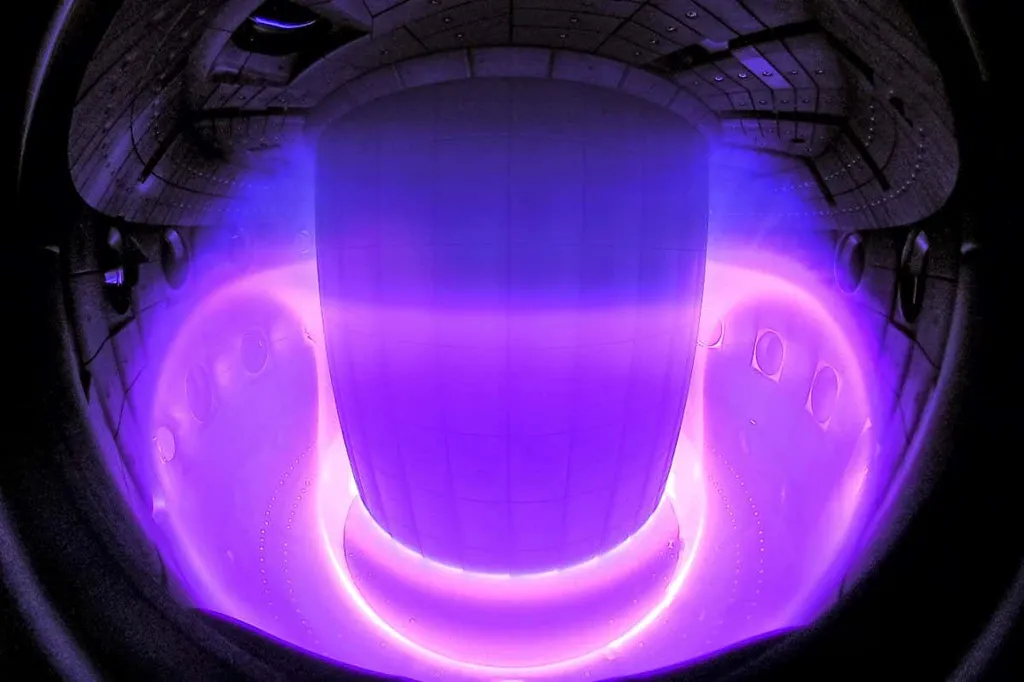
In the realm of fusion energy research, understanding the behavior of plasmas is crucial. A team of researchers from various institutions, including Los Alamos National Laboratory and the University of California, have been working on improving the models used to simulate these complex systems. Their recent work focuses on enhancing the accuracy and efficiency of collisional-radiative (CR) models, which are essential for predicting the radiative properties and ionization balance in fusion plasmas.
The researchers, Prashant Sharma, Christopher J. Fontes, Mark Zammit, James Colgan, Nathan Garland, and Xian-Zhu Tang, have developed hybrid CR models that strike a balance between detailed accuracy and computational efficiency. These models are applied to helium, lithium, and beryllium, elements commonly found in fusion plasmas. The hybrid approach retains detailed fine-structure states up to selected principal quantum numbers, while higher-lying states are statistically averaged to form superconfigurations. This method allows for a more efficient calculation without significantly sacrificing accuracy.
The team applied these hybrid models to compute radiative power loss, as well as average and effective charge states, across a wide range of electron temperatures and densities. The results were benchmarked against a fully fine-structure-resolved CR model to ensure the hybrid approach’s accuracy. The findings, published in the Journal of Quantitative Spectroscopy & Radiative Transfer, demonstrate the versatility of hybrid CR schemes and their suitability for detailed plasma simulations. This research is particularly relevant for the energy sector, as it can lead to more accurate and efficient simulations of fusion plasmas, ultimately aiding in the development of fusion energy technologies.
The practical applications of this research extend beyond fusion energy. Improved CR models can also enhance the simulation of other high-energy-density plasmas, such as those found in astrophysical phenomena or inertial confinement fusion experiments. By providing a more accurate understanding of plasma behavior, these models can contribute to advancements in various energy-related fields. The researchers’ work highlights the importance of balancing computational efficiency with predictive fidelity, a principle that can guide future developments in plasma modeling and simulation.
This article is based on research available at arXiv.