
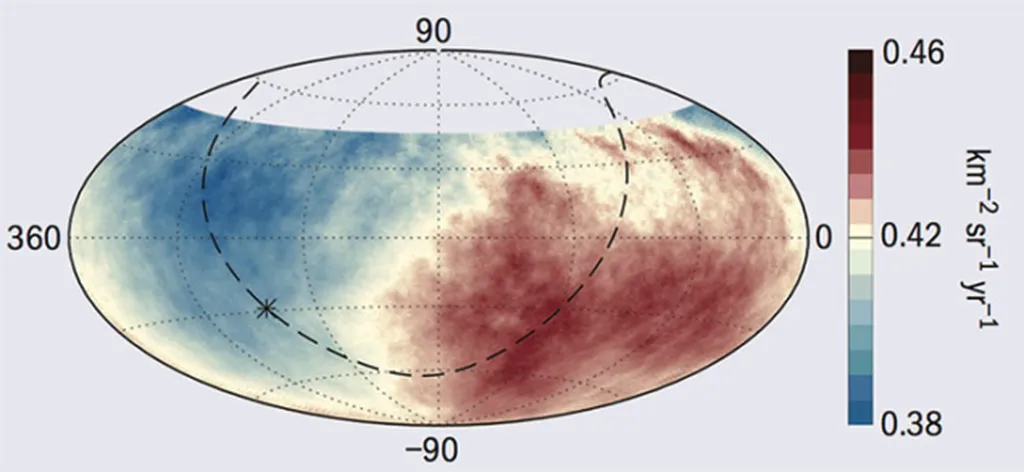
In the realm of astrophysics and energy research, understanding the origins of cosmic rays is a puzzle that has long intrigued scientists. Among those delving into this mystery are researchers A. D. Supanitsky and S. E. Nuza, affiliated with the Instituto de Física de Rosario, Argentina, and the Universidad de Antioquia, Colombia, respectively. Their recent study explores the potential role of accretion shocks in galaxy clusters as sources of ultrahigh-energy cosmic rays (UHECRs), offering insights that could have implications for the energy sector.
Cosmic rays are high-energy particles that constantly bombard Earth from space. The most energetic of these, UHECRs, have energies millions of times higher than those produced in human-made accelerators like the Large Hadron Collider. Recent findings from the Pierre Auger Observatory have provided strong evidence that these UHECRs originate from outside our galaxy. However, their exact sources remain a mystery. One proposed source is accretion shocks in galaxy clusters. These shocks are immense, spanning millions of light-years, and are created when material from the intergalactic medium falls into the gravitational wells of galaxy clusters.
In their study, Supanitsky and Nuza investigate whether these accretion shocks could indeed be the sources of UHECRs. They consider nearby massive galaxy clusters, like the Virgo Cluster, as discrete sources, while less massive and distant clusters are treated as a continuous distribution based on known cluster mass statistics. The researchers fit the flux of cosmic rays measured at Earth and the composition profile observed by the Pierre Auger Observatory, assuming that different nuclear species are injected by these sources.
Their findings suggest that cosmic ray acceleration in cluster accretion shocks could account for a significant portion of the observed UHECR flux at energies below a certain threshold, known as the suppression scale. However, at higher energies, direct acceleration from the thermal pool would only be feasible under specific conditions. These conditions include local fluctuations that create magnetic fields about an order of magnitude stronger than typically expected in cluster accretion shocks, or particular configurations of the shock normal and magnetic field.
For the energy industry, understanding the origins and behavior of cosmic rays is crucial. Cosmic rays can impact the performance and lifespan of satellites and other space-based assets, which are integral to modern energy infrastructure, including renewable energy systems and global communication networks. By identifying the sources of UHECRs, researchers can better predict and mitigate the risks posed by these high-energy particles. Additionally, the acceleration mechanisms studied in astrophysical contexts can inspire new approaches to particle acceleration in controlled environments, potentially leading to advancements in fusion energy research and other cutting-edge energy technologies.
The research by Supanitsky and Nuza was published in the journal Physical Review D, contributing to the ongoing efforts to unravel the mysteries of cosmic rays and their implications for both astrophysics and the energy sector.
This article is based on research available at arXiv.