
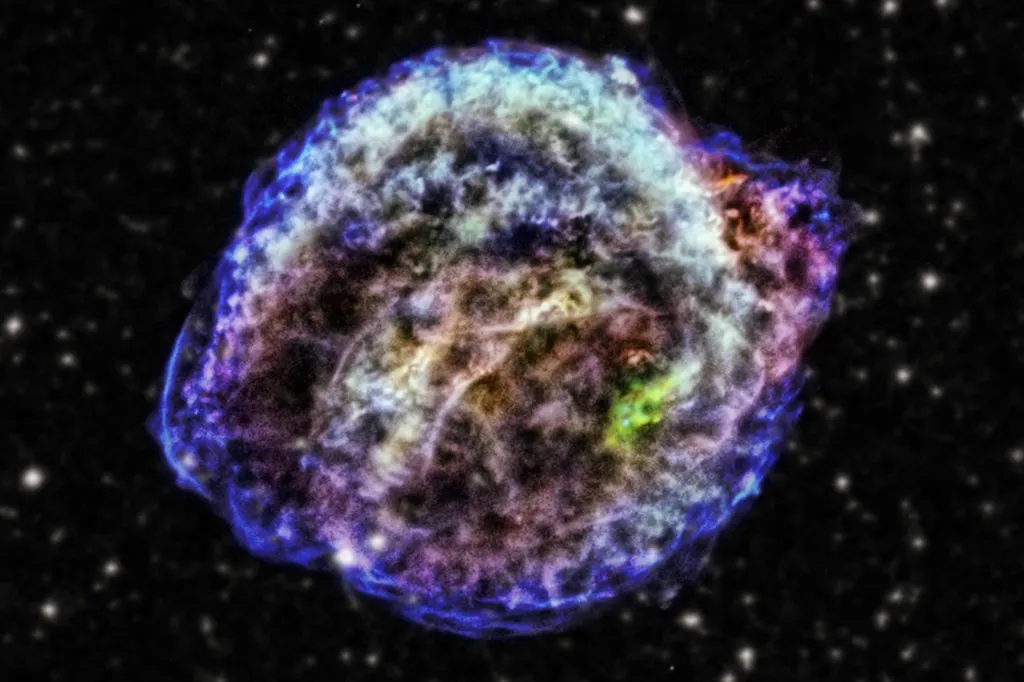
In the realm of astrophysics and energy research, a team of scientists from various institutions, including Nagoya University, the University of Tokyo, and the University of Western Sydney, has been delving into the mysteries of supernova remnants (SNRs) and their role in cosmic-ray acceleration. Their recent study, published in the Astrophysical Journal, focuses on two specific SNRs, W41 and G22.7-0.2, both of which emit high-energy gamma rays.
The researchers, led by Takeru Murase, utilized high-angular-resolution data from the Nobeyama 45-m telescope and the Very Large Array (VLA) to investigate the spatial and kinematic properties of molecular and atomic gas interacting with these SNRs. They identified associated gas clouds in specific velocity ranges for each SNR, with molecular hydrogen dominating the target protons and atomic hydrogen contributing less than 10-15%.
The study revealed mean proton densities of approximately 1.2×10^3 cm^-3 for W41 and 5.3×10^2 cm^-3 for G22.7-0.2. By analyzing the gamma-ray luminosities, the team estimated the total energy of accelerated cosmic-ray protons, finding values of around 3×10^47 erg for W41 and 1×10^48 erg for G22.7-0.2. These energies correspond to a small fraction (0.03-0.1%) of the canonical supernova explosion energy.
The researchers noted that these energy values align with the decreasing trend observed in middle-aged SNRs within the previously reported SNR age-energy relation. This study contributes to our understanding of cosmic-ray acceleration and the role of SNRs in this process. While the direct practical applications for the energy sector may not be immediately apparent, the insights gained from such research can inform the development of advanced energy technologies, such as those involving plasma physics and high-energy particle interactions. Additionally, understanding the fundamental processes in the universe can inspire innovative approaches to energy generation and management.
Source: Astrophysical Journal
This article is based on research available at arXiv.