
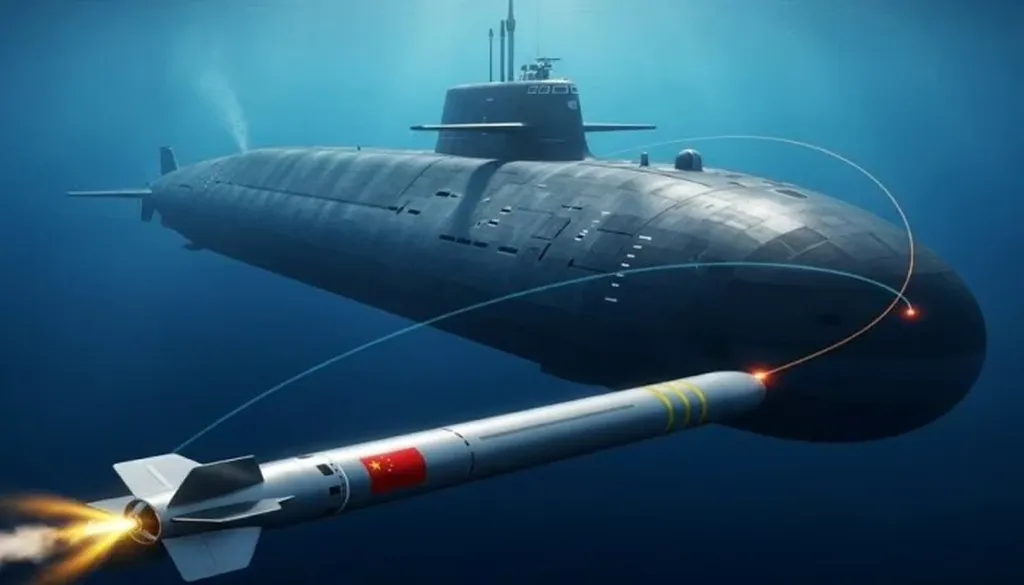
Researchers from the School of Aeronautics and Astronautics at Zhejiang University in China have conducted a comprehensive study on wall-pressure fluctuations in submarine models, with significant implications for the energy and defense sectors. The team, led by Peng Jiang and including Haoyu Zhang, Yi Dai, Tao Peng, Bin Xie, and Shijun Liao, published their findings in the Journal of Fluid Mechanics, a highly respected publication in the field of fluid dynamics.
The study addresses a critical gap in hydroacoustics by investigating wall-pressure fluctuations on the fully appended DARPA SUBOFF model, a standard submarine model used for research purposes. The experiments were conducted in a wind tunnel at operationally relevant Reynolds numbers, which are a measure of the flow’s velocity and viscosity. The researchers examined baseline straight-ahead flow, complex maneuvering conditions, and the effects of a novel vortex control baffle (VCB).
One of the key findings is that the appendages on the submarine significantly amplify noise. Specifically, unstable horseshoe vortex dynamics at the sail-hull junction drive localized pressure fluctuations of up to 300%. This means that the interaction between the water flow and the submarine’s appendages creates turbulent vortices that generate noise. The researchers found that these vortices are a major source of coherent noise, which is noise that has a predictable pattern and can be more easily detected.
To mitigate this issue, the study provides the first experimental validation of the VCB. This device works by physically suppressing the formation of horseshoe vortices at the sail-hull junction. The VCB achieves a significant reduction in wall-pressure fluctuations, with a 35% decrease at the stern and an approximately 14% reduction along the parallel mid-body of the submarine. This means that the VCB can make submarines quieter, which is crucial for military applications where stealth is important.
The study also found that maneuvering conditions fundamentally reshape the pressure field, introducing substantial crossflow effects and non-monotonic spectral behaviors. This means that when a submarine changes direction or pitch, the way water flows over its surface changes, which can affect its noise profile. Understanding these dynamics is important for designing submarines that can operate quietly in a variety of conditions.
The comprehensive dataset and the demonstrated efficacy of the VCB provide essential physical insights and a critical validation benchmark for the design of next-generation quiet submarines. This research could have significant implications for the energy sector as well, particularly in the design of underwater turbines and other marine energy devices. By understanding and mitigating the sources of noise in underwater environments, researchers can improve the efficiency and reliability of these devices.
In conclusion, this study provides valuable insights into the hydroacoustics of submarines and offers a practical solution for reducing noise in underwater environments. The findings could have wide-ranging applications in the defense and energy sectors, contributing to the development of quieter, more efficient underwater technologies.
This article is based on research available at arXiv.