
Researchers from the University of Cambridge, including Lucu M., Martinez-Laserna E., Gandiaga I., Liu K., Camblong H., Widanage W. D., and Marco J., have developed a new data-driven approach to predict the ageing of lithium-ion batteries. Their work, published in the Journal of Energy Storage, aims to leverage real-world operational data to improve the accuracy of battery ageing models, reducing the need for extensive laboratory testing.
Traditional methods for predicting lithium-ion battery ageing, such as electrochemical, semi-empirical, and empirical models, often require significant time and resources to achieve accurate predictions under realistic conditions. However, with the increasing adoption of telemetry technology in the energy industry, a wealth of real-world battery operation data is becoming available. This presents an opportunity to develop ageing models that can learn from this in-field data, mitigating the need for exhaustive laboratory testing.
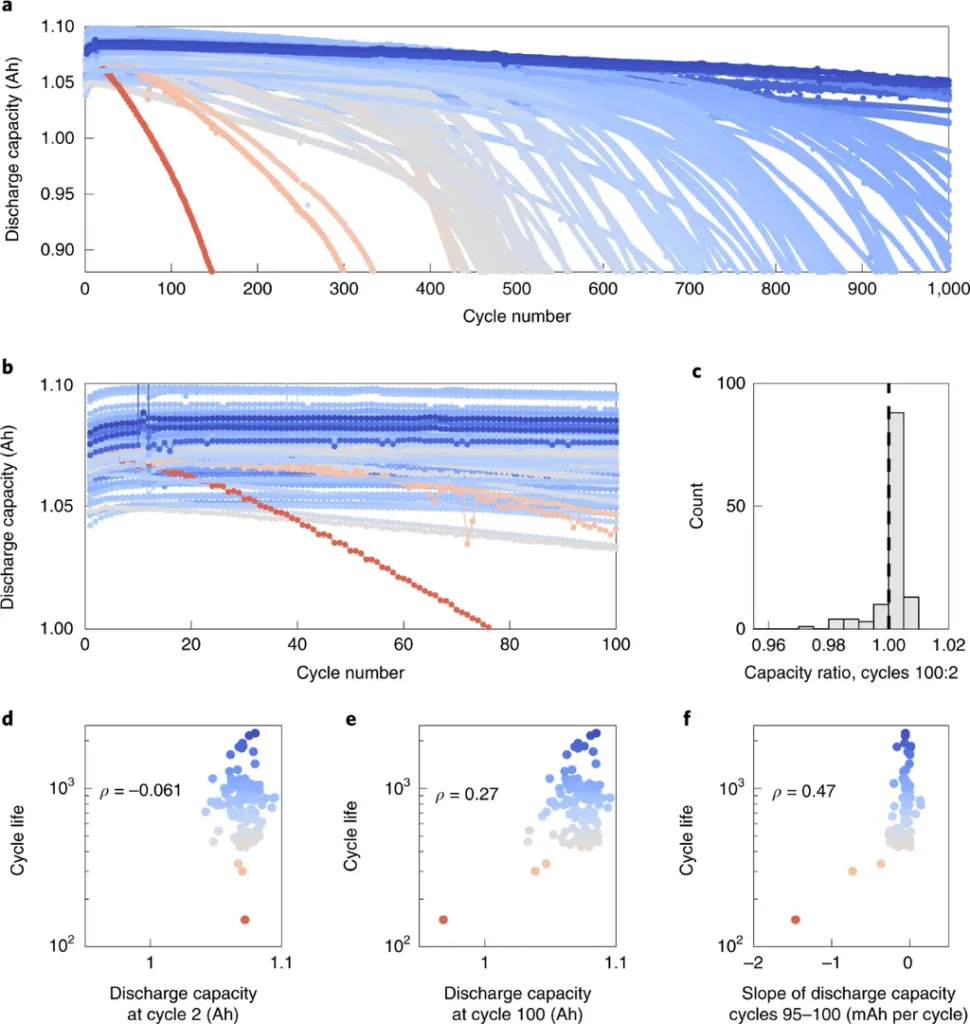
In a two-part series, the researchers developed a data-driven ageing model for lithium-ion batteries using the Gaussian Process framework. The first paper focused on calendar ageing, while the second paper, which we will discuss here, addresses ageing under cycling operation. The researchers composed a specific covariance function tailored for battery ageing applications and tested it on an extensive dataset involving 124 cells over more than three years.
The model was trained using different subsets of the data to determine the minimal number of laboratory tests required for an accurate ageing model. Impressively, a model trained with just 26 tested cells achieved an overall mean-absolute-error of 1.04% in capacity curve prediction. This model was validated under a broad range of both dynamic and static cycling temperatures, depths of discharge, middle states of charge, and charging and discharging rates.
For the energy industry, this research offers a promising approach to predict battery ageing more accurately and efficiently. By learning from real-world operational data, the model can adapt to a wide range of operating conditions, providing more confident predictions. This could lead to improved battery management strategies, enhanced safety, and more effective use of energy storage systems. Furthermore, the reduced need for laboratory testing could lower the costs associated with battery research and development.
In conclusion, the researchers have demonstrated a data-driven approach to lithium-ion battery ageing that leverages real-world operational data. This method shows potential for improving the accuracy of ageing predictions and reducing the need for extensive laboratory testing, offering practical benefits for the energy industry.
This article is based on research available at arXiv.