
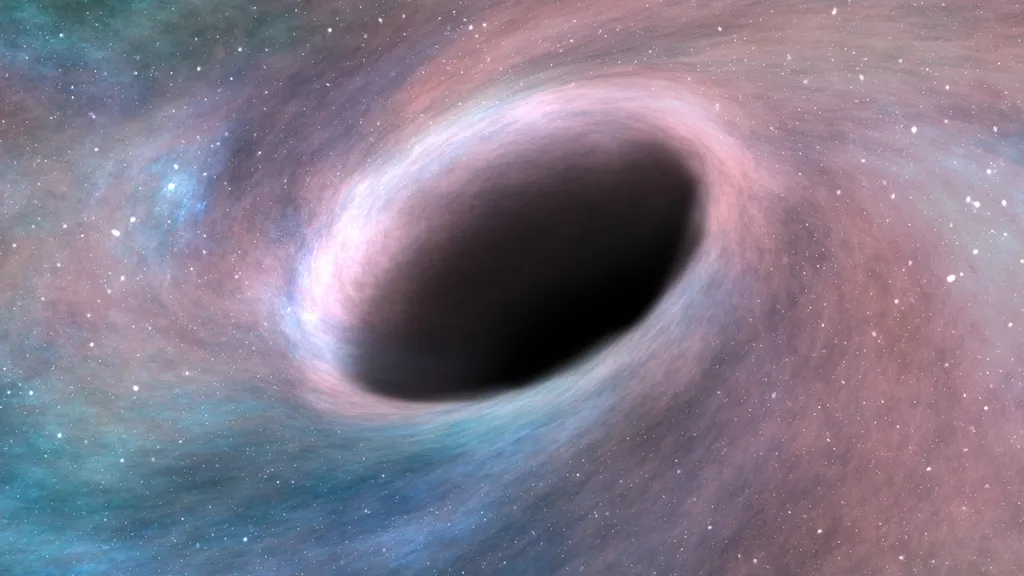
Dr. Chris Done, a professor of astrophysics at Durham University, has been studying the behavior of black holes, both stellar-mass and supermassive, and their impact on the surrounding environment. Her research, published in the journal Nature Astronomy, sheds light on the complex interplay between the accretion disks, jets, and winds emanating from these cosmic objects, providing insights that could have practical applications for the energy sector.
Black holes are among the simplest objects in the universe, characterized primarily by their mass and spin. However, the rate at which they accrete matter also plays a crucial role in their behavior. Dr. Done’s research reveals that there is a significant transition in the spectral properties of black holes when the accretion rate reaches about 1% of the Eddington luminosity, the theoretical maximum luminosity a black hole can achieve. At this threshold, the optically thick accretion disk is replaced by a hot flow, which dramatically alters the black hole’s emission spectrum.
This spectral change also affects the properties of thermal and radiatively powered winds, which are streams of particles ejected from the vicinity of the black hole. The new XRISM data from stellar-mass black holes in binary systems support this framework, although additional winds driven by ultraviolet radiation and dust can also occur in supermassive black holes. The research also clarifies the relationship between the hot flow and the radio jets, which are narrow beams of particles ejected at near-light speeds. The radio data from both stellar-mass and supermassive black holes indicate that the hot flow, rather than the accretion disk, connects to the radio jet.
The radio-X-ray ‘fundamental plane,’ a relationship between the radio and X-ray emissions of black holes, can be qualitatively understood if most black holes have low to moderate spins. In these cases, the jet power is set as a constant fraction of the accretion power. However, a small fraction of active galactic nuclei (AGN), known as radio-loud AGN, exhibit much higher radio-to-X-ray ratios. Dr. Done speculates that these AGN have higher jet power due to high black hole spin.
Despite these advancements, several issues remain unresolved, primarily related to the geometry and nature of the X-ray corona, the region of hot, high-energy particles surrounding the black hole. Reflection spectroscopy and polarimetry provide conflicting constraints on this region, highlighting the need for further research.
For the energy sector, understanding the behavior of black holes and their jets could have implications for the development of advanced energy technologies. The study of high-energy astrophysical phenomena can inspire innovations in plasma physics, particle acceleration, and magnetic field dynamics, which are relevant to fusion energy research and other cutting-edge energy technologies. Moreover, the fundamental understanding of energy transfer and conversion processes in extreme environments can provide valuable insights for improving energy efficiency and sustainability on Earth.
This article is based on research available at arXiv.