
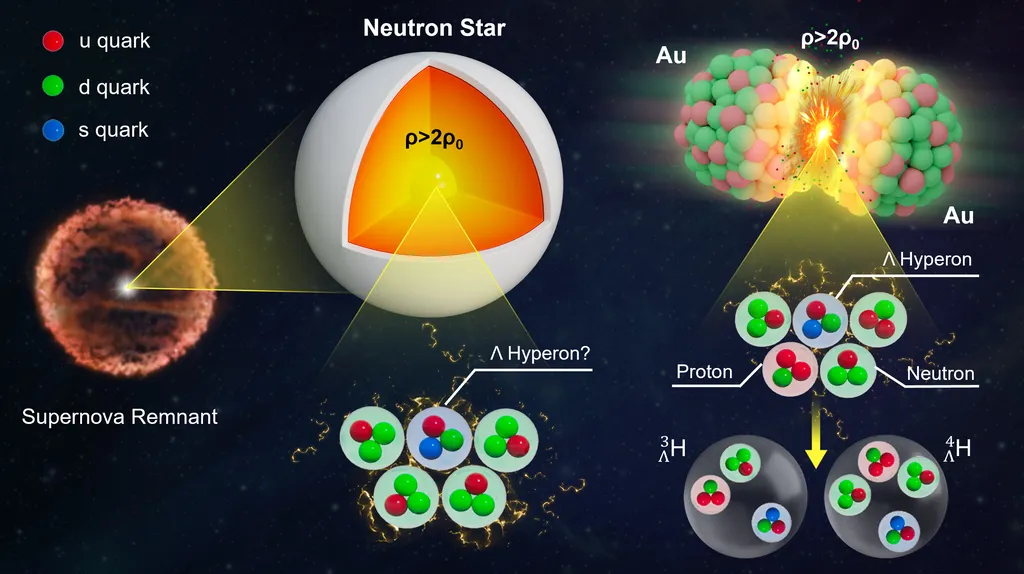
Researchers from the University of Zagreb, including P. S. Koliogiannis, T. Ghosh, E. Yuksel, and N. Paar, have uncovered a new relationship that connects the properties of atomic nuclei to those of neutron stars, offering a novel approach to understanding the behavior of matter under extreme conditions. Their findings, published in the journal Physical Review Letters, could have significant implications for the energy sector, particularly in the development of nuclear energy and the study of astrophysical phenomena.
The nuclear equation of state, which describes how the properties of nuclear matter change under different conditions, is crucial for understanding the structure and behavior of neutron stars. However, this equation is subject to considerable theoretical uncertainties, leading to variations in predicted observables. To address this issue, the researchers identified a universal relation that links the properties of finite nuclei to those of neutron stars. This relation involves a dimensionless quantity called ζ, which couples the compactness of a neutron star with a mass of 1.4 times that of the Sun to the slope of the nuclear symmetry energy at saturation.
The researchers demonstrated that ζ exhibits a strong exponential correlation with the electric dipole polarizability (α_D) in finite nuclei across a broad range of equations of state. By utilizing experimental data on α_D for selected neutron-rich nuclei, they were able to constrain ζ and translate these constraints into bounds on the neutron star radius (R_1.4) and the symmetry-energy slope (L). This approach provides a framework-independent method for understanding the properties of neutron star matter, reducing the model dependence inherent in previous methods.
For the energy sector, this research offers a new avenue for exploring the behavior of nuclear matter under extreme conditions, which could have applications in the development of advanced nuclear energy technologies. By providing a more accurate understanding of the nuclear equation of state, this work could contribute to the design of safer and more efficient nuclear reactors, as well as the development of new materials for energy storage and conversion. Additionally, the insights gained from this research could enhance our understanding of astrophysical phenomena, such as neutron star mergers, which are of interest to both the scientific community and the energy industry.
In summary, the researchers have identified a universal relation that bridges the properties of finite nuclei and neutron stars, offering a novel approach to constraining the nuclear equation of state. This work, published in Physical Review Letters, provides valuable insights into the behavior of matter under extreme conditions and has potential applications in the energy sector, particularly in the development of advanced nuclear energy technologies and the study of astrophysical phenomena.
This article is based on research available at arXiv.