
Researchers from Lawrence Livermore National Laboratory, including Heather D. Whitley, Michael S. Murillo, John I. Castor, Liam G. Stanton, Lorin X. Benedict, Philip A. Sterne, James N. Glosli, and Frank R. Graziani, have published a study in the Journal of Chemical Physics that explores the application of improved Kelbg potentials to understand the behavior of carbon plasmas under extreme conditions.
The study focuses on developing a general form for the electron-ion diffractive potential, which is derived from the quantum pair density matrix and fitted to the improved Kelbg potential for atomic numbers up to Z = 54. The researchers applied classical molecular dynamics using the improved Kelbg potential for carbon, coupled with various forms of the Pauli potential, to compute internal energies and pressures for hot, dense plasma conditions.
The results were compared to an equation of state model based on path integral Monte Carlo and density functional theory simulations. This comparison aimed to assess how well the improved Kelbg potential could reproduce the internal energy and pressure of carbon plasmas. The researchers found that the regions of validity for carbon generally aligned with those previously derived for hydrogen, once pressure ionization effects were incorporated.
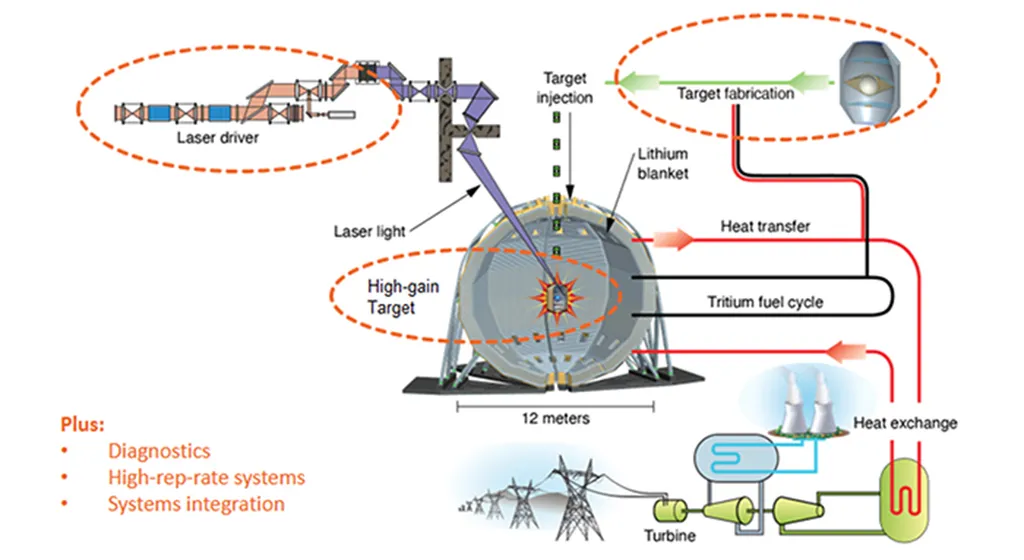
The study highlights the general applicability and limitations of these potentials for equation of state studies in warm dense matter and high energy density plasmas. This research is particularly relevant to the energy sector, as understanding the behavior of plasmas under extreme conditions can inform the development of advanced energy technologies, such as fusion energy and high-energy density physics applications.
The research was published in the Journal of Chemical Physics, providing a valuable contribution to the field of plasma physics and its practical applications in energy research.
Source: Journal of Chemical Physics
This article is based on research available at arXiv.