
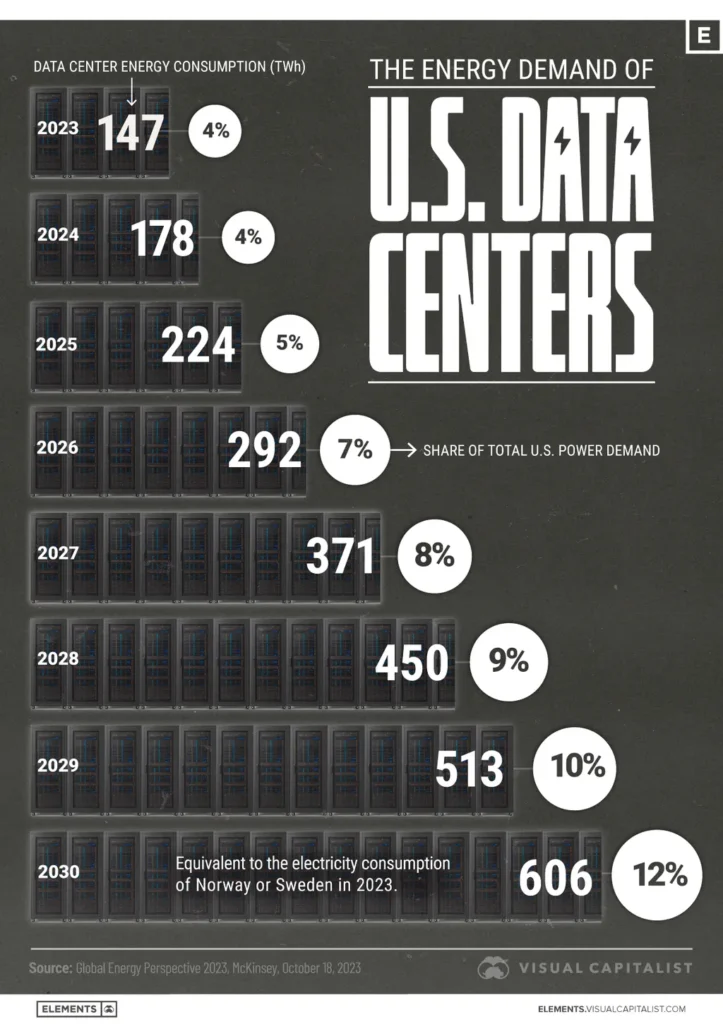
The U.S. electricity sector is on the cusp of a dramatic shift, with demand expected to surge by 25% by 2030 and over 75% by 2050, compared to 2023 levels. This transformation is largely driven by the rapid expansion of data centers, fueled by the artificial intelligence (AI) boom. For utilities, this presents both unprecedented challenges and significant opportunities.
The sheer scale of the demand is staggering. A single hyperscale data center can consume over 100 MW of power, equivalent to the annual consumption of up to 400,000 electric cars. This sudden, concentrated demand is akin to a new town springing up overnight, and it’s a challenge that utilities are not currently equipped to handle.
The primary hurdle is the uneven distribution of this demand across utilities’ systems. Existing infrastructure was not designed to accommodate such localized, intense power needs. Utilities will need to overhaul their systems, rather than making piecemeal adjustments. This could involve increasing conductor capacity, replacing towers, or even constructing new transmission lines. If new generation plants are required, these can take years to build, necessitating interim solutions like non-wire alternatives or distributed energy resources.
Staffing shortfalls pose another significant challenge. Utilities typically have enough engineers to handle routine upgrades, but few have the excess workforce and infrastructure to manage the sudden demand from new data centers. Connecting these centers to the grid requires a deep understanding of generation capacity, transmission, and distribution. Utilities must assess their internal expertise and consider bringing in outside help if necessary.
Regulatory and logistical roadblocks also need to be navigated. Utilities must evaluate their systems’ ability to support the massive demand of new data centers. They need to consider generation capacity, the time required to build new facilities, permitting and regulation, and the financial stakes involved. The good news is that the administration is changing requirements to encourage AI advancements, potentially streamlining the permitting process at the federal level.
Despite these challenges, the AI and data center wave also presents a significant growth opportunity for utilities. Those that plan early, draw on external expertise, and adapt creatively will emerge stronger, with expanded infrastructure and enhanced revenue. The AI revolution is underway, and the question now is how quickly utilities can seize this opportunity.
This surge in demand could accelerate the transition to a more resilient, modern grid. It could also drive innovation in energy storage, demand response, and other technologies that can help manage this new load. Moreover, it could spur investment in renewable energy, as data centers increasingly seek to power their operations with clean energy.
However, the path forward is not without its pitfalls. Utilities must balance the need for rapid action with the importance of careful planning. They must also manage the financial stakes, as these projects often require investments in the millions or billions, with cost recovery stretched over decades.
In the end, the AI boom is a test for utilities. But with the right strategies, it’s a test they can pass, emerging stronger and more resilient than ever before. The question is, are they ready to meet the challenge?