
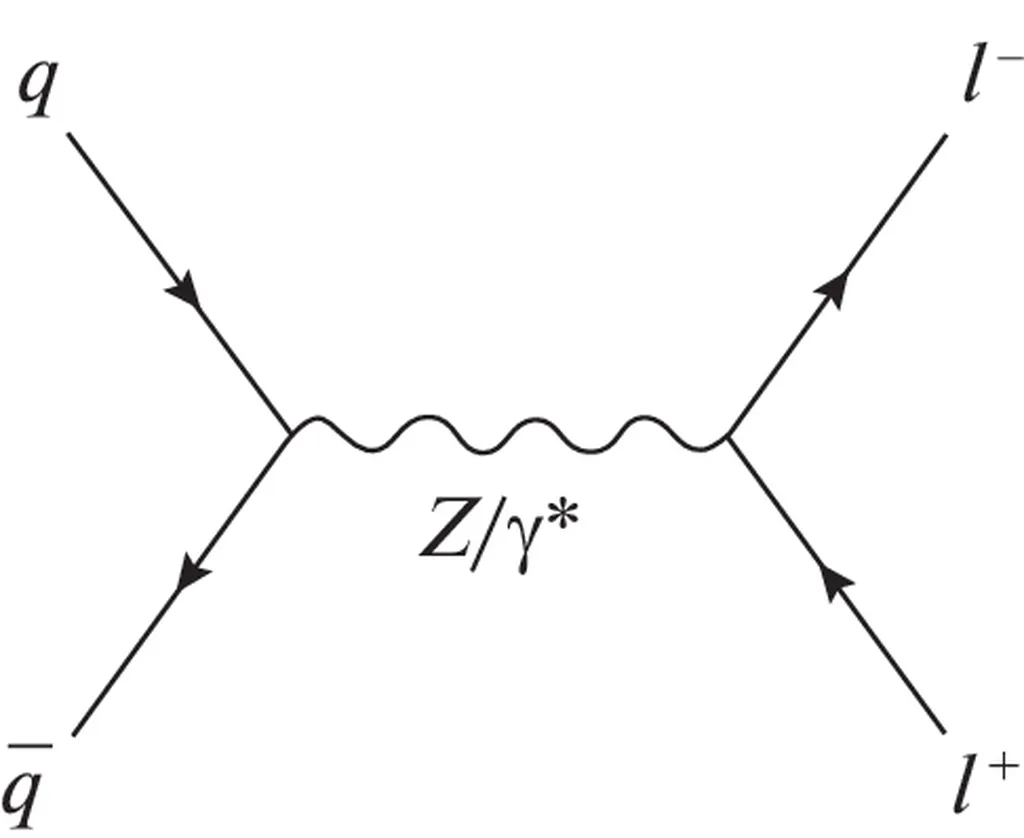
In the realm of high-energy physics, a team of researchers led by K. Nagai from the University of Tokyo, along with collaborators from various institutions including Argonne National Laboratory and the University of New Mexico, has recently published intriguing findings on the angular distributions of Drell-Yan muons. Their work, titled “Measurements of Angular Distributions of Drell-Yan Dimuons in p+p and p+d Interactions at 120 GeV/c,” was published in the journal Physical Review Letters.
The study focuses on the interactions of a 120 GeV/c proton beam with liquid hydrogen and deuterium targets, specifically examining the angular distributions of muons produced through the Drell-Yan process. This process involves the annihilation of quarks and antiquarks within the protons, resulting in the creation of muon pairs. The researchers measured these distributions in both polar and azimuthal angles within a specific kinematic range, which includes the mass of the muon pairs (4.5 < mμμ < 10 GeV/c²), their transverse momentum (0.19 < pT < 2.24 GeV/c), and the Feynman xF variable (0 < xF < 0.95). One of the most notable findings of this research is the observation of a pronounced cos 2φ modulation in the angular distributions. This modulation was not observed in previous higher-energy proton-induced Drell-Yan experiments, making this result particularly intriguing. The researchers compared their data with predictions from perturbative Quantum Chromodynamics (pQCD), the theoretical framework that describes the strong interactions of quarks and gluons. The comparison revealed statistically significant deviations, with p-values of 3.5% for the p+p interactions and 1.5% for the p+d interactions. These deviations suggest that nonperturbative QCD contributions may be at play, offering new insights into the complex dynamics of quark and gluon interactions. For the energy sector, particularly in the realm of nuclear energy and particle accelerators, understanding these fundamental interactions is crucial. The insights gained from this research could potentially lead to advancements in the design and operation of high-energy particle accelerators, which are used in various applications, including medical imaging, cancer treatment, and materials research. Furthermore, a deeper understanding of QCD could contribute to the development of more efficient and effective nuclear energy technologies. In summary, the research conducted by Nagai and colleagues provides valuable data on the angular distributions of Drell-Yan muons, highlighting the presence of nonperturbative QCD contributions. These findings not only advance our fundamental understanding of particle physics but also hold practical implications for the energy sector, particularly in the development and optimization of high-energy particle accelerators and nuclear energy technologies. This article is based on research available at arXiv.