
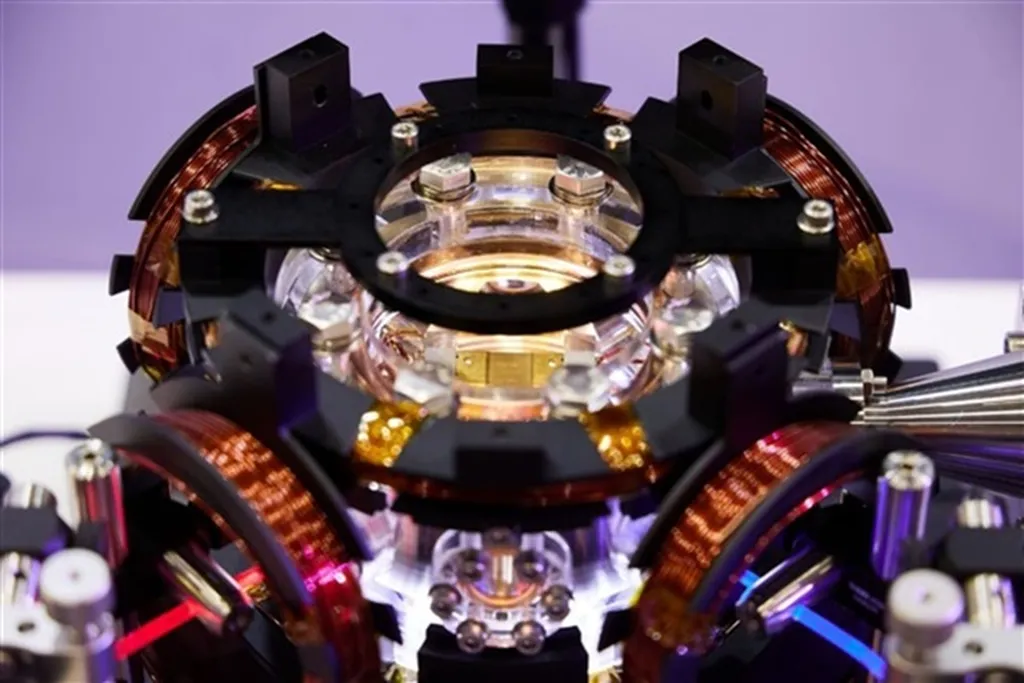
Researchers from the National Taiwan University, led by Ting Hsu and Guin-Dar Lin, have proposed a novel approach to quantum computing that could significantly improve the scalability and efficiency of trapped-ion quantum computers. Their work, published in the journal Physical Review Letters, introduces a new method for entangling stationary and mobile ion qubits, which could facilitate long-distance entanglement distribution and reduce the need for cooling and stabilization.
In their study, the researchers address a key challenge in quantum computing: the heating and instability introduced when ions are moved and reintegrated into an array. This process, known as ion shuttling, is a critical component of quantum charge-coupled device (QCCD) architectures, but it requires significant time and laser power for cooling and stabilization. To mitigate these issues, the team proposed a new entangling scheme that allows a stationary ion qubit to interact with a continuously transported mobile ion, which remains in uniform motion and minimizes motional heating.
The researchers theoretically demonstrated that their approach could achieve a gate error on the order of 0.01%, which is within reach of current technology. This level of accuracy is comparable to other state-of-the-art quantum computing methods, but with the added benefit of reduced resource consumption and improved scalability. The proposed scheme could enable resource-efficient quantum operations and facilitate long-distance entanglement distribution, where stationary trapped-ion arrays serve as memory units and mobile ions act as communication qubits passing beside them.
The practical applications of this research for the energy sector are not immediately apparent, as quantum computing is still an emerging technology with a range of potential applications. However, as quantum computing continues to develop, it could have significant implications for energy optimization, grid management, and other areas of the energy industry. For example, quantum computers could be used to optimize the distribution of energy across a grid, or to model complex chemical reactions for the development of new energy storage materials. The researchers’ proposed method for entangling stationary and mobile ion qubits could be a significant step towards realizing the full potential of quantum computing for these and other applications.
In summary, the researchers from National Taiwan University have proposed a novel approach to quantum computing that could improve the scalability and efficiency of trapped-ion quantum computers. Their work, published in Physical Review Letters, introduces a new method for entangling stationary and mobile ion qubits that minimizes motional heating and reduces the need for cooling and stabilization. While the practical applications of this research for the energy sector are not yet clear, the proposed method could be a significant step towards realizing the full potential of quantum computing for a range of applications.
This article is based on research available at arXiv.