
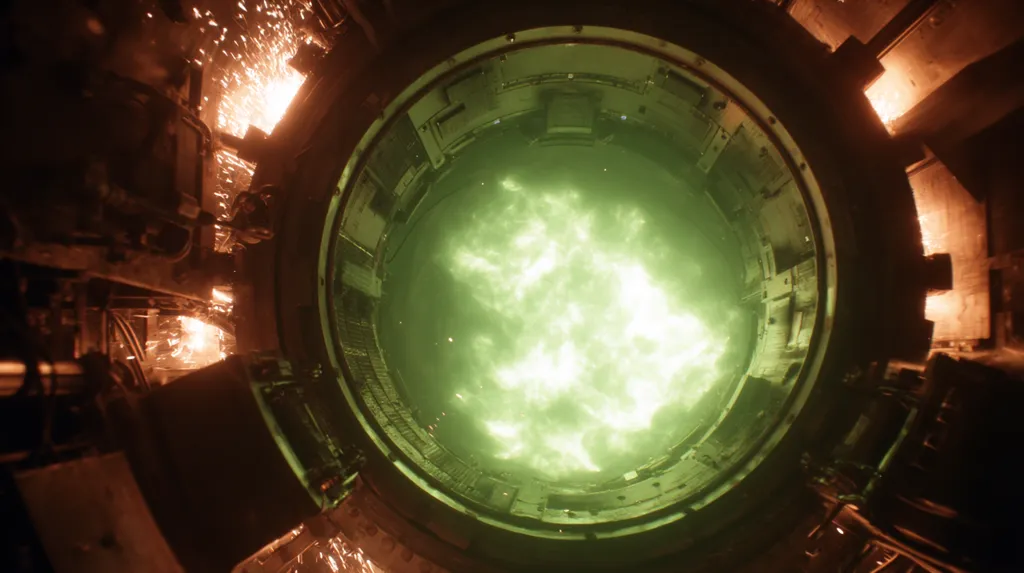
In the realm of astrophysics and energy research, a team of scientists from various institutions, including Heidelberg University, the Max Planck Institute for Astrophysics, and Monash University, have been delving into the intricate processes of electron-capture supernovae (ECSNe). These celestial events are typically believed to culminate in the collapse into a neutron star, but recent studies suggest that a thermonuclear explosion could also be a possible outcome. The researchers aimed to map out the conditions that determine whether an ECSN results in an explosion or a collapse.
The team conducted a comprehensive parameter study involving 56 three-dimensional hydrodynamic simulations of ECSN in oxygen-neon (ONe) white dwarfs. They utilized a level set based flame model implemented in the Leafs code. The study varied both the ignition location and the central density at ignition to identify the conditions of the transition regime between explosion and collapse. Additionally, the researchers explored two different laminar flame parameterizations and their impact on the simulation outcomes.
The findings revealed a transition density range between logρ_c^ini=10.0 and 10.15 g cm^-3, depending on the ignition location and the laminar flame speed parameterization used. Notably, the study highlighted that at sufficiently high central densities, the burned ashes can sink into the core, trapping large amounts of neutron-rich material in the bound remnant. In the transition regime, the laminar flame speed was found to play a critical role by suppressing the formation of instabilities and thereby reducing the nuclear energy generation needed to overcome the collapse.
The research also demonstrated that a thermonuclear explosion is possible for a wide range of parameters. Interestingly, a more off-center ignition allows for higher central densities to still result in an explosion. The conditions at ignition and the flame physics were identified as critical factors in determining the outcome of ECSNe. The study underscores the necessity of detailed 3D hydrodynamic simulations of the preceding stellar evolution and the ignition process of the thermonuclear flame to accurately predict the outcome of ECSNe.
This research, published in the journal Astronomy & Astrophysics, provides valuable insights into the complex mechanisms driving electron-capture supernovae. Understanding these processes can have implications for the energy sector, particularly in the context of nuclear fusion research. The findings contribute to the broader scientific endeavor to harness the power of nuclear fusion, which could potentially revolutionize energy production by providing a clean, abundant, and sustainable energy source.
The practical applications for the energy sector lie in the potential to inform and advance fusion research. By understanding the conditions and mechanisms that lead to thermonuclear explosions in astrophysical contexts, scientists can gain insights into controlling and optimizing fusion reactions here on Earth. This could accelerate the development of fusion power plants, which promise to deliver energy with minimal environmental impact and virtually limitless fuel supply.
In summary, the study by Holas et al. sheds light on the intricate balance between explosion and collapse in electron-capture supernovae. The findings not only deepen our understanding of astrophysical phenomena but also hold promise for advancing fusion energy research, potentially bringing us closer to a future powered by clean, sustainable nuclear fusion.
This article is based on research available at arXiv.