
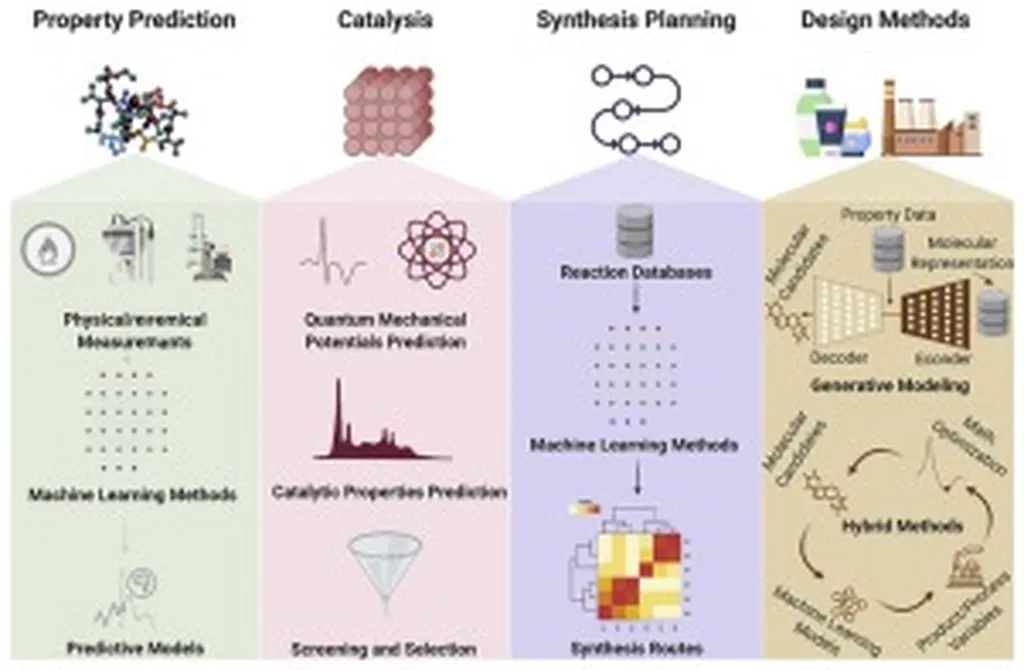
In the rapidly evolving field of energy research, the integration of machine learning techniques is opening new avenues for molecular simulations, which are crucial for understanding and developing advanced materials and chemical processes. Researchers Peter Eastman, Evan Pretti, and Thomas E. Markland from Stanford University have conducted a comprehensive study to benchmark the performance of various pretrained Machine Learning Interatomic Potentials (MLIPs). Their work, published in the journal Nature Communications, provides a critical evaluation of these models, offering valuable insights for practitioners in the energy sector.
The study focuses on 15 pretrained MLIPs, assessing each model’s accuracy, speed, memory use, and stability in simulations. The researchers found that the number of model parameters and the size of the training set are strongly correlated with accuracy. This means that larger models trained on extensive datasets tend to perform better. Interestingly, the study also revealed that training on charged molecules and including explicit Coulomb energy terms are less essential for achieving high accuracy than previously thought. This finding could simplify the development of MLIPs, making them more accessible and efficient for practical applications.
Speed and memory use were found to be influenced as much by the model architecture as by the size of the model. This suggests that optimizing the architecture can lead to more efficient simulations without compromising on accuracy. For the energy industry, this is particularly significant as it means that researchers can choose models that balance computational efficiency with accuracy, depending on the specific requirements of their simulations.
The practical applications of this research are vast. In the energy sector, molecular simulations are used to study the properties of materials for batteries, catalysts, and other energy-related technologies. By selecting the most appropriate MLIP, researchers can accelerate the discovery and development of new materials, leading to more efficient and sustainable energy solutions. The benchmarks provided by this study offer a reliable guide for choosing the right model, ensuring that simulations are both accurate and efficient.
In summary, the work by Eastman, Pretti, and Markland provides a valuable resource for practitioners in the energy sector, helping them navigate the rapidly expanding landscape of pretrained MLIPs. By understanding the factors that influence model performance, researchers can make informed decisions, ultimately advancing the field of energy research and development. The study was published in Nature Communications, a reputable journal known for its high-quality research in the natural sciences.
This article is based on research available at arXiv.