
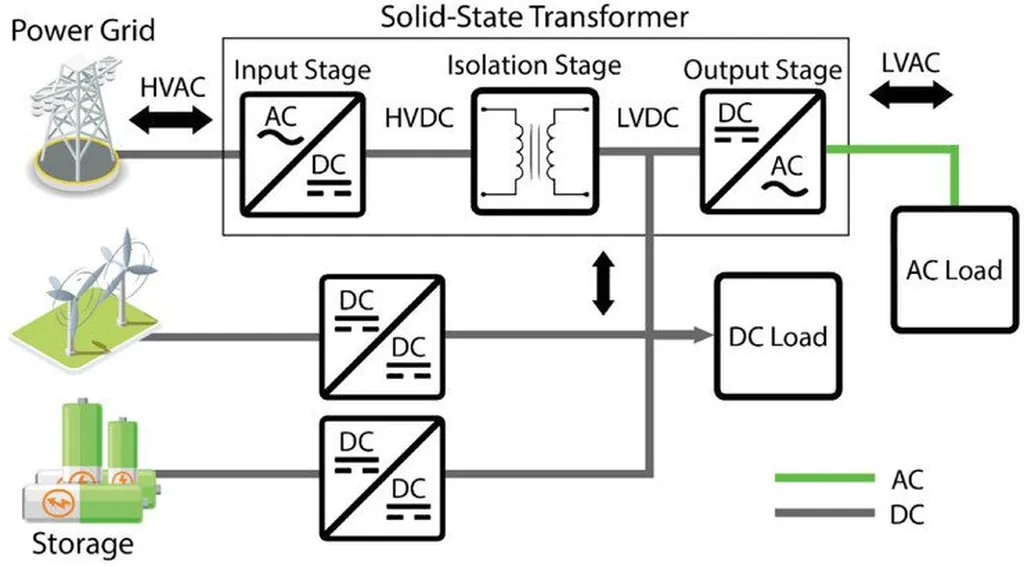
Researchers from the University of Hong Kong, led by Jian Xu and including Xinxiong Jiang, Yi Bao, Yuchen Zheng, Xuhui Chen, Qiang Xu, Siyang Liao, Deping Ke, and Xiaoqi Gao, have explored a novel approach to power delivery in data centers, particularly those handling artificial intelligence (AI) workloads. Their work, published in the IEEE Transactions on Power Electronics, addresses the growing demand for efficient and robust power systems in data centers driven by the rapid increase in AI workloads and rack power density.
The study focuses on the development of a solid-state transformer (SST)-driven 800 VDC architecture designed to convert 10 kV medium-voltage AC (MVAC) to an 800V low-voltage DC (LVDC) bus. This architecture employs a three-phase H-bridge AC/DC stage cascaded with a dual-active-bridge (DAB) DC/DC stage. The researchers implemented a coordinated closed-loop control scheme that combines rectifier voltage/current regulation and DAB phase-shift control to maintain DC-bus voltage stability. This approach aims to overcome the limitations of conventional uninterruptible power supply (UPS) systems, which involve multiple conversion stages and line-frequency transformers, leading to compounded losses and reduced compatibility with dynamic AI power profiles.
The proposed system was evaluated using real-time digital simulation (RTDS) and sequential simulations with real-world day- and month-scale operating profiles of data centers. The results were benchmarked against a traditional UPS supply chain. The numerical studies demonstrated tight 800 VDC regulation, reduced input-side energy consumption compared to the UPS baseline, and satisfactory power-quality performance. Additionally, a capacitance sensitivity test was conducted to quantify the tradeoffs between DC-bus ripple and low-frequency input-power oscillations, providing a practical capacitance range for design considerations.
The research offers a reproducible evaluation workflow and actionable guidance for the development of next-generation AI data centers. The findings highlight the potential of SST-driven 800 VDC architectures to enhance energy efficiency and power quality in data centers, addressing the unique demands of AI workloads. This work provides valuable insights for the energy sector, particularly in the design and implementation of advanced power delivery systems for high-performance computing environments.
This article is based on research available at arXiv.