
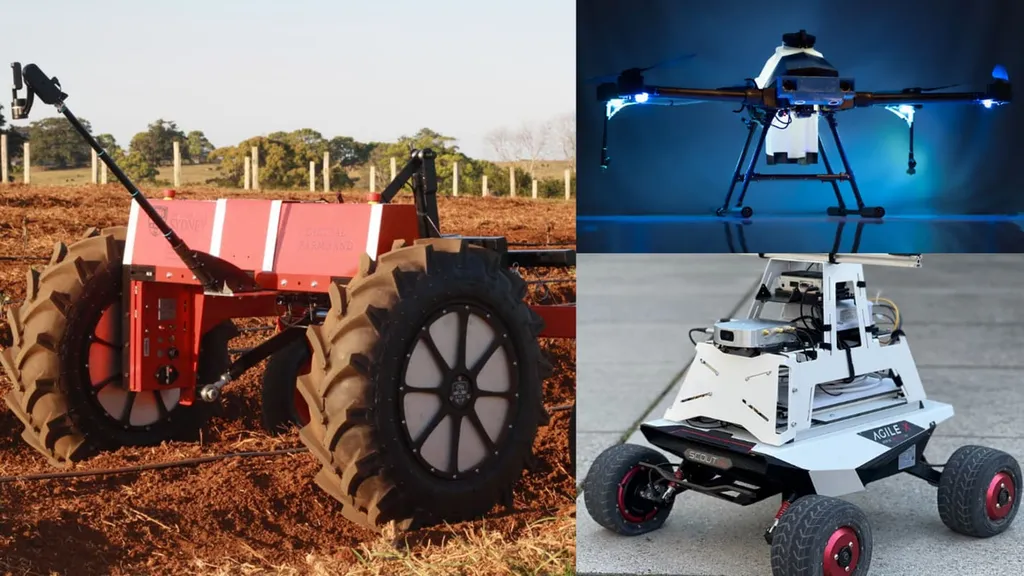
In the realm of agricultural robotics, a team of researchers from the University of Melbourne, including Beining Wu, Zihao Ding, Leo Ostigaard, and Jun Huang, has developed a novel approach to optimize energy usage in agricultural robots. Their work, published in the IEEE Robotics and Automation Letters, focuses on improving Coverage Path Planning (CPP), a crucial function for agricultural robots that often faces energy constraints.
The researchers have proposed an energy-aware CPP framework that leverages Soft Actor-Critic (SAC) reinforcement learning. This framework is designed for grid-based environments with obstacles and charging stations. To enable robust and adaptive decision-making under energy limitations, the framework integrates Convolutional Neural Networks (CNNs) for spatial feature extraction and Long Short-Term Memory (LSTM) networks for temporal dynamics.
A dedicated reward function is designed to jointly optimize coverage efficiency, energy consumption, and return-to-base constraints. The experimental results demonstrate that the proposed approach consistently achieves over 90% coverage while ensuring energy safety. This represents a significant improvement over traditional heuristic algorithms such as Rapidly-exploring Random Tree (RRT), Particle Swarm Optimization (PSO), and Ant Colony Optimization (ACO), with coverage improvements ranging from 13.4% to 19.5% and constraint violations reduced by 59.9% to 88.3%.
For the energy sector, this research highlights the potential of reinforcement learning in optimizing energy usage in robotic systems. The proposed framework could be adapted for use in energy inspection robots, such as those used in power plants or wind farms, where energy efficiency and coverage are critical. The ability to integrate spatial and temporal data could also prove valuable in predicting and managing energy demand in various settings. The research was published in the IEEE Robotics and Automation Letters, a reputable source for advancements in robotics and automation.
This article is based on research available at arXiv.