
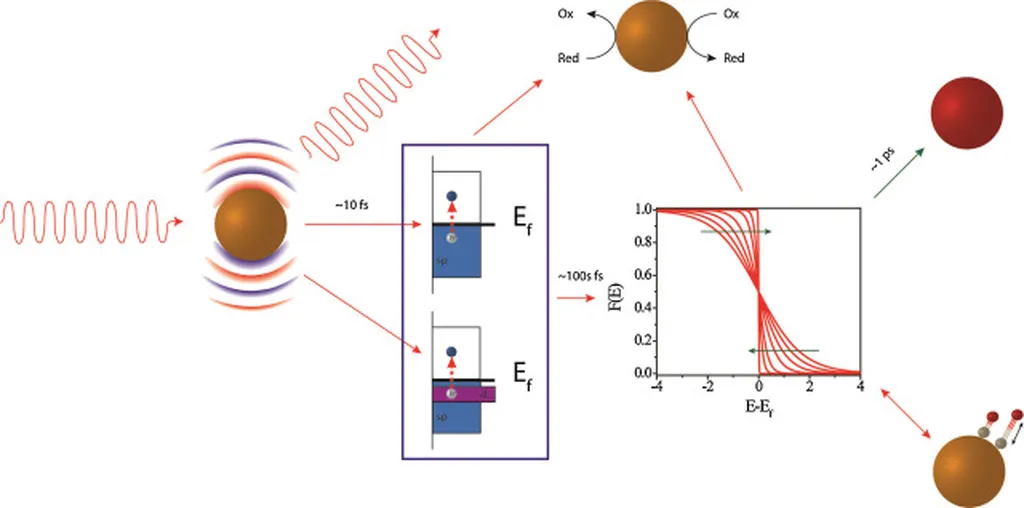
Researchers Paulo S. S. dos Santos, João P. Mendes, José M. M. M. de Almeida, and Luís C. C. Coelho, affiliated with the University of Coimbra in Portugal, have developed a novel method for rapidly calculating localized surface plasmon resonances (LSPR) in metallic nanoparticles. This research, published in the journal “ACS Photonics,” offers a significant advancement in the field of plasmonics, with potential applications in sensing, nano-optics, and energy harvesting.
Localized surface plasmon resonances are collective oscillations of electrons at the surface of metallic nanoparticles, which can be harnessed for various applications. Accurate and fast calculations of these resonances are crucial for designing and optimizing plasmonic devices. However, traditional methods such as the boundary element method (BEM) and the discrete dipole approximation (DDA) can be computationally expensive, limiting their use in rapid parametric studies.
The researchers introduced an ultrafast method that simplifies the calculation process by focusing solely on the dipolar component of the induced surface charge density. By expanding this component into a Cartesian dipole basis, they created a compact 3×3 geometric formulation that avoids the need for solving large eigenproblems. This approach allows for the rapid evaluation of the spectral response by projecting the Neumann-Poincaré surface operator onto the dipole subspace and evaluating a Rayleigh quotient, yielding geometry-only eigenvalues without an NxN eigenproblem.
One of the major advantages of this method is its efficiency. All geometry-dependent quantities are computed once per nanoparticle, while material dispersion and environmental changes are incorporated through simple algebraic expressions for the polarizability. This enables rapid evaluation across wavelengths. Additionally, retardation effects are included through the modified long-wavelength approximation (MLWA), extending the method’s accuracy into the weakly retarded regime.
For the energy sector, this research offers practical applications in the design and optimization of plasmonic nanoparticles for energy harvesting. Plasmonic nanoparticles can enhance the absorption of light in solar cells, leading to improved efficiency. The ultrafast modeling method developed by the researchers can significantly speed up the design process, allowing for rapid parametric studies and optimization of plasmonic structures for solar energy applications. Furthermore, the method’s efficiency makes it a valuable tool for other applications in sensing and nano-optics, contributing to advancements in various energy-related technologies.
This article is based on research available at arXiv.