
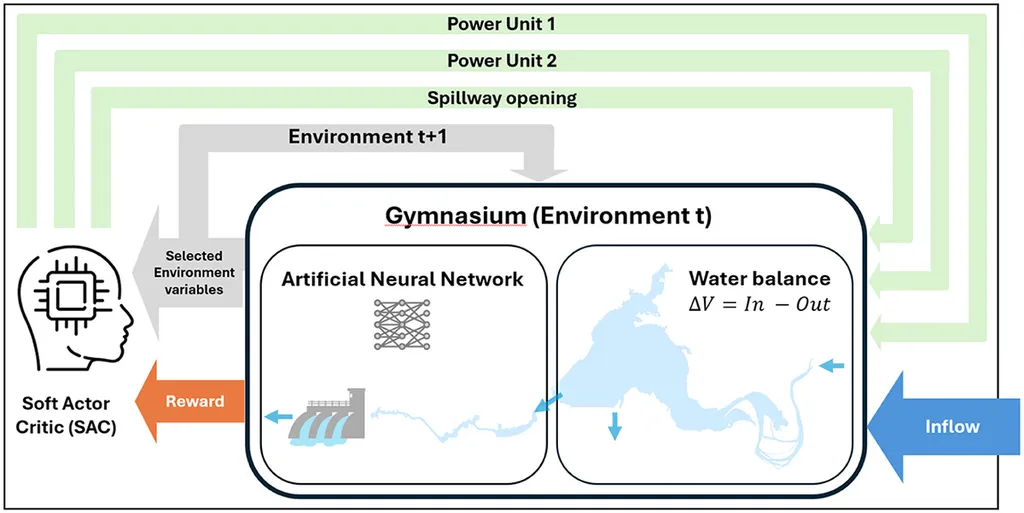
Researchers Maria do Rosario de Pinho and Maria Margarida A. Ferreira from the University of Porto, along with Georgi Smirnov from the University of Aveiro, have published a study on optimizing the control of hydroelectric power plants with uncontrolled spillways. Their work focuses on maximizing power production profit while adhering to operational constraints, particularly the management of reservoir water levels.
Hydroelectric power plants are a critical component of the global energy mix, providing a renewable and reliable source of electricity. However, their efficiency and profitability can be significantly impacted by how well their operations are managed, especially in the case of cascaded plants where water flow is sequential. The researchers tackled a specific challenge: the presence of uncontrolled spillways, which are safety features that release excess water from reservoirs but cannot be directly managed by plant operators.
The study addresses the discontinuous nature of these spillways and their activation at state boundaries, which complicates the application of standard optimal control methods. To overcome this, the researchers developed a novel approach by approximating the original problem through a sequence of standard optimal control problems using exponential penalty functions. This method allows for the derivation of necessary conditions for optimality, which are crucial for developing effective control strategies.
The practical implications of this research are significant for the energy sector. By optimizing the control of hydroelectric power plants, operators can enhance power production efficiency and profitability. This is particularly important in regions where hydroelectric power is a major energy source, as it can lead to more sustainable and cost-effective energy production. The researchers illustrated the applicability of their conditions with an example, demonstrating the potential real-world impact of their findings.
The study was published in the journal “IMA Journal of Mathematical Control and Information,” a peer-reviewed publication that focuses on mathematical control theory and its applications. The research highlights the importance of advanced mathematical techniques in solving complex problems in the energy sector, paving the way for more efficient and sustainable hydroelectric power generation.
This article is based on research available at arXiv.