
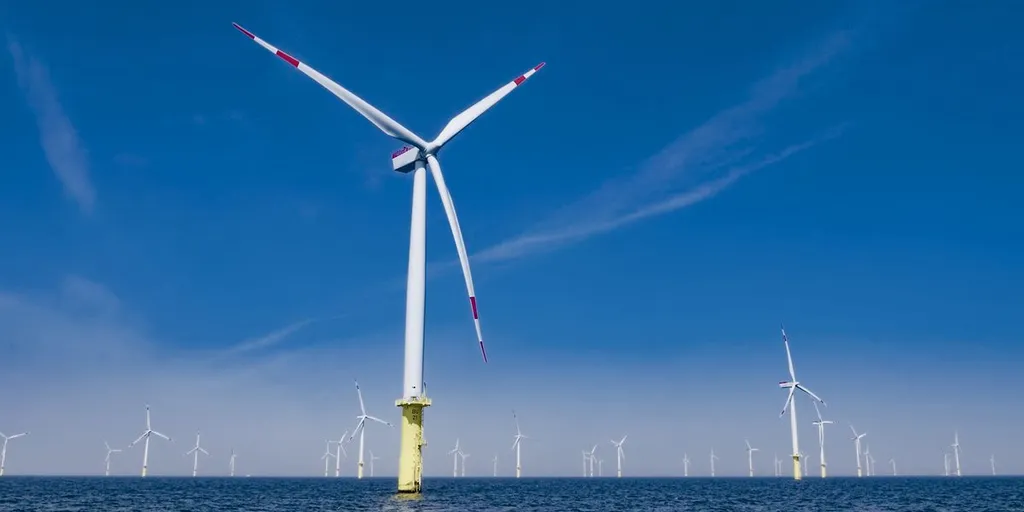
As the world shifts towards cleaner energy sources, offshore wind farms are becoming increasingly important. However, integrating these farms with Modular Multilevel Converter-based High-Voltage Direct Current (MMC-HVDC) transmission systems presents unique challenges for power system protection. Researchers from the Federal University of Juiz de Fora and the Universitat Politècnica de Catalunya have been investigating these challenges, with a focus on the performance of differential protection applied to collector cables in offshore wind farms.
The team, led by Moisés J. B. B. Davi and including Felipe V. Lopes, Vinícius A. Lacerda, Mário Oleskovicz, and Oriol Gomis-Bellmunt, has published their findings in the IEEE Transactions on Power Delivery. Their research highlights the limitations of conventional differential protection schemes in these systems. The issue stems from the fact that both ends of the collector cables are supplied by Inverter-Based Resources (IBRs), which modify the magnitude and characteristics of fault currents.
The researchers used electromagnetic transient simulations of a representative offshore wind farm, modeled in PSCAD/EMTDC software, to assess internal and external fault scenarios. They varied fault types and resistances to evaluate the sensitivity and selectivity of differential protection. The study found that conventional differential protection schemes may not be sufficient for these systems, as they do not account for sequence components that are affected by IBRs.
The research suggests that enhanced strategies, which consider these sequence components, could improve the performance of differential protection in offshore wind farms with MMC-HVDC transmission. This is crucial for ensuring the reliability and stability of future converter-dominated grids. The findings provide valuable insights for the energy industry, guiding the development of more robust protection schemes for offshore wind farms. As the world continues to transition towards low-carbon energy, this research will be instrumental in overcoming the technical challenges associated with integrating renewable energy sources into the grid.
The research was published in the IEEE Transactions on Power Delivery, a leading journal in the field of power systems engineering. The study’s practical applications are significant for the energy sector, particularly for companies involved in offshore wind farm development and HVDC transmission system design. By implementing the enhanced protection strategies suggested by this research, the industry can ensure the safe and efficient operation of these complex systems.
This article is based on research available at arXiv.