
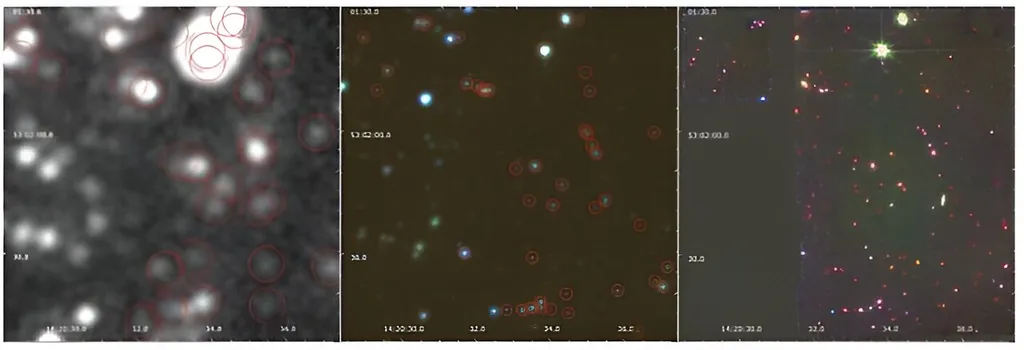
In the realm of energy and astrophysics, a team of researchers led by Kameron Goold from the University of Kentucky, along with colleagues from various institutions including the Space Telescope Science Institute, the University of Washington, and the Max Planck Institute for Astronomy, has made significant strides in understanding low-luminosity active galactic nuclei (LLAGN) using the James Webb Space Telescope (JWST). Their work, published in the Astrophysical Journal, offers new insights into the behavior of these celestial objects, which could have implications for our understanding of energy processes in the universe.
The researchers presented near- and mid-infrared spectra of eight LLAGN, spanning a wide range in black hole mass and Eddington ratio. The high spatial resolution of JWST allowed them to separate AGN emission from host-galaxy contamination, enabling detections of high-ionization potential lines that were previously too faint to measure. This capability is crucial for energy research as it helps in understanding the energy output and processes in the vicinity of supermassive black holes, which are central to many galaxies.
The study revealed a transition point at an Eddington ratio of around -3.5, where the spectral energy distribution becomes increasingly deficient in ultraviolet photons. This finding is significant because it sheds light on the energy distribution and efficiency of these low-luminosity AGN. Additionally, the researchers found that the rotational H2 excitation temperatures in these objects are elevated compared to both higher-luminosity AGN and star-forming galaxies. This suggests that the molecular gas in these regions is warmer, which could influence the energy dynamics and feedback processes in the interstellar medium.
The team also discussed the potential roles of outflows, jets, and X-ray dominated regions in shaping the interstellar medium surrounding LLAGN. Understanding these processes is essential for energy research as they can affect the energy balance and evolution of the host galaxies. Furthermore, the detection of silicate emission at around 10 micrometers, localized to the nuclear region, in most of the ReveaLLAGN targets, provides additional insights into the composition and energy processes in these regions.
Overall, this comprehensive JWST-based characterization of infrared emission lines in the nuclear regions of LLAGN offers valuable data for energy researchers. The findings can help refine models of energy production and distribution in active galactic nuclei, contributing to our broader understanding of the energy dynamics in the universe. The research was published in the Astrophysical Journal, a leading journal in the field of astrophysics and energy-related studies.
This article is based on research available at arXiv.