
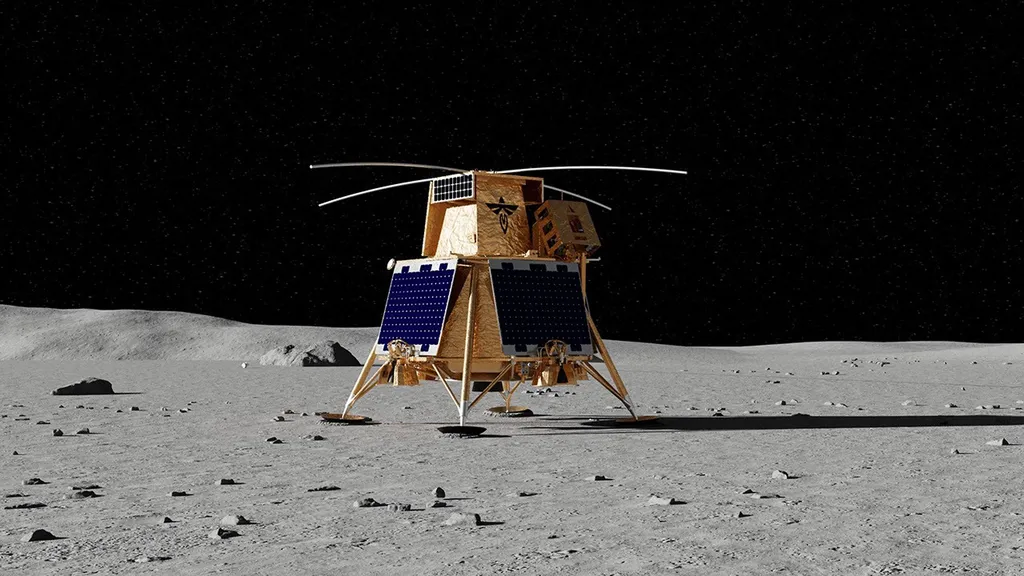
In a collaborative effort, researchers from the University of Colorado Boulder, Arizona State University, Caltech, the University of California Berkeley, the University of Pennsylvania, and NASA’s Goddard Space Flight Center have proposed an ambitious project called FarView. This initiative aims to deploy a low-frequency radio interferometer on the far side of the Moon, leveraging the Moon’s unique radio-quiet environment to open a new window for astronomical observations.
The FarView project, as outlined in a recent study published in the journal “Experimental Astronomy,” proposes a radio array consisting of 100,000 crossed dipole antennas. This array would be configured in a dense core-halo layout, spanning an area of 200 square kilometers. The primary goal of FarView is to measure the redshifted 21 cm signal from the Cosmic Dark Ages, a period in the universe’s history that is currently poorly understood. This measurement is identified as a priority area in the Astro2020 Decadal Survey, a comprehensive review of astronomy and astrophysics research priorities.
The proposed array’s design includes a compact 4 km core with 83,000 dipoles, which would maximize sensitivity to large-scale cosmological modes. Additionally, 20,000 halo elements extending to 14 km would provide angular resolution and calibration for foreground characterization. The researchers predict that FarView could achieve a 10-sigma detection of the Dark Ages 21 cm power spectrum at a redshift of 30 over five years of half-duty cycle lunar night observations.
Beyond its primary cosmological objectives, FarView would also enable interferometric imaging of low-frequency solar radio bursts, advancing space weather studies. The array could also facilitate stellar space weather observations, Galactic cosmic ray tomography via free-free absorption, and searches for auroral radio emission from exoplanet magnetospheres, which could provide insights into exoplanet habitability.
For the energy sector, the technologies and methodologies developed for FarView could have practical applications. For instance, the signal processing techniques and data analysis methods could be adapted for use in energy systems that rely on radio frequency signals, such as wireless power transfer and communication systems. Additionally, the space weather studies enabled by FarView could provide valuable data for improving the resilience of energy infrastructure to solar events.
In summary, the FarView project represents a significant opportunity to establish the Moon as a platform for foundational astrophysics while delivering unique observational capabilities. The project’s ambitious goals and innovative design could also yield practical benefits for the energy sector, demonstrating the potential for interdisciplinary collaboration in scientific research.
This article is based on research available at arXiv.