
A team of international researchers, led by Adélaïde Claeyssens from the University of Geneva and Angela Adamo from Stockholm University, has made a significant stride in understanding the formation and evolution of star clusters in the early universe. Their findings, published in the prestigious journal Nature Astronomy, provide valuable insights that could potentially influence our understanding of energy generation and black hole formation in the cosmos.
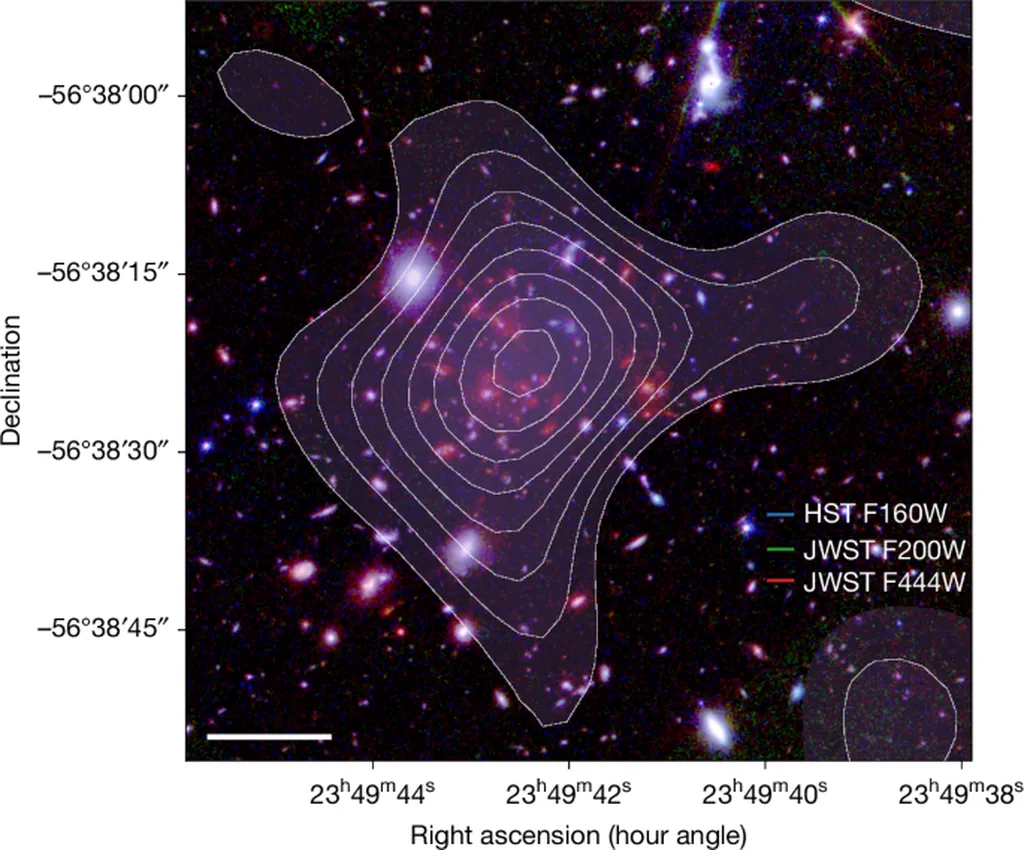
The researchers utilized the James Webb Space Telescope’s Near-Infrared Camera (JWST/NIRCam) to observe 222 high-redshift star clusters, detected in 78 magnified galaxies from different galaxy cluster fields. The majority of these systems were observed in the very deep NIRCam observations of the cluster Abell S1063, as part of the GLIMPSE program. This demonstrates the power of combining deep observations with gravitational lensing to reveal primordial stellar structures.
The team performed simultaneous size-flux estimates in all available NIRCam filters and spectral energy distribution (SED) fitting analysis to determine the physical properties of these star clusters. They found that all star cluster candidates had very high magnification. Notably, star clusters and clumps showed similar ages and redshift distributions, but differed in their masses, sizes, and stellar surface densities. This discrepancy is likely due to the lack of resolution in the latter group.
The researchers reconstructed the formation redshift of star clusters and discovered that the majority of the observed star clusters were young, with ages less than 100 million years, and seemed to form at cosmic noon (1 < z < 4). A small sample of cosmic noon star clusters was found to be about 1 billion years old, suggesting that these potential globular clusters formed well within cosmic reionization. The star clusters were found to have stellar densities ranging from 10^2 to 10^6 solar masses per square parsec, with median values around 10^4 solar masses per square parsec. Their sizes and densities better overlapped with those of nuclear star clusters in the local universe. These intrinsic properties make high-redshift star clusters a viable channel to grow intermediate-mass black holes. Using Bayesian inference, the team made the first direct measurement of the star cluster mass function at redshifts greater than 1, based on a subsample of 60 star clusters younger than 100 million years and with masses above 2 million solar masses. The star cluster mass function was well described by a power-law with a slope of -1.89, suggesting that a power-law of -2 function might already be in place in the distant universe. In the context of the energy industry, understanding the formation and evolution of star clusters and black holes can provide insights into the processes that drive energy generation in the universe. This research could potentially contribute to the development of new energy technologies inspired by astrophysical processes. This article is based on research available at arXiv.