
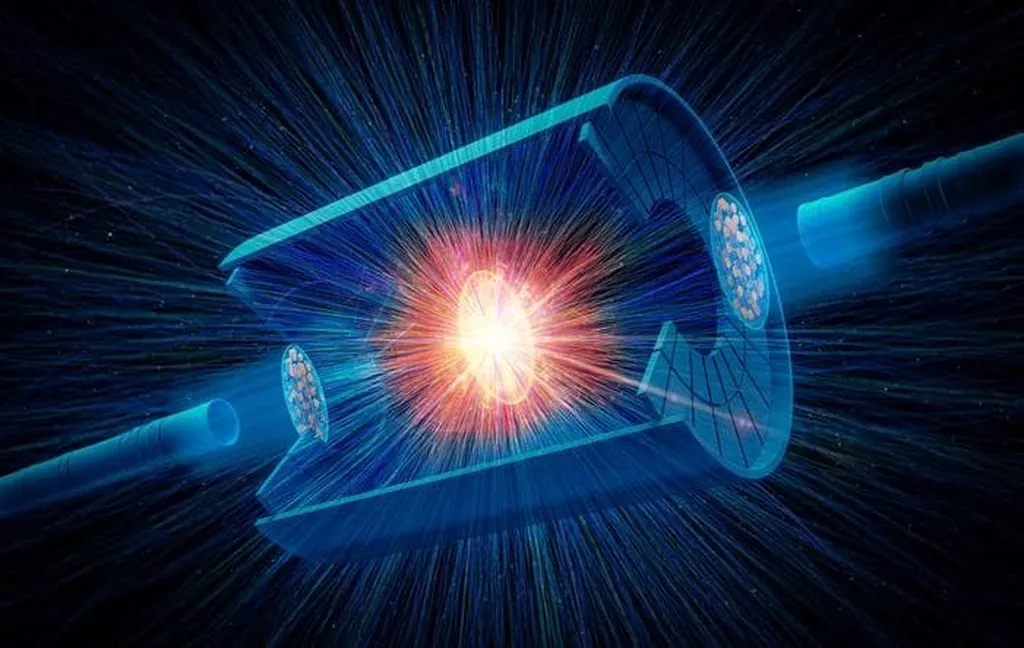
In the realm of high-energy physics, researchers Zhixiang Yang and Jianhong Ruan from the Institute of High Energy Physics in China have been delving into the intricacies of proton-proton collisions at the Large Hadron Collider (LHC). Their work, published in the journal Physical Review D, offers insights that could have implications for understanding fundamental particle interactions and potentially influencing energy-related technologies.
The study focuses on a minimal, gluon-driven framework to describe the charged-particle multiplicities and their pseudorapidity densities in high-energy collisions. The researchers employed a two-component model that includes the hard gluon-gluon fusion process and the soft quark recombination process. This model directly relates to both integrated and unintegrated parton distributions, which are essential for understanding the internal structure of protons.
The researchers began by evolving Parton Distribution Functions (PDFs) using the Modified Dokshitzer-Gribov-Lipatov-Altarelli-Parisi (MD-DGLAP) equations. These PDFs were then converted into unintegrated PDFs (UPDFs) via the Kimber-Martin-Ryskin (KMR) scheme. The resulting PDFs and UPDFs were incorporated into the two-component model to predict the charged-particle pseudorapidity density in proton-proton collisions at LHC energies. The predictions were compared to data from the ATLAS experiment, revealing that the model effectively captures the features of the observed pseudorapidity distributions, despite its simplicity.
One of the key findings is that gluon-gluon fusion processes dominate particle production for collision energies of 900 GeV and above. This provides phenomenological support for MD-DGLAP-based PDFs and the associated small-x gluon dynamics. The researchers also performed a comparative analysis of results from alternative PDF sets, including CTEQ, MSHT, NNPDF, HERAPDF, and GRV, focusing on their consistency with the relative shapes of experimental data in the small-x region.
While this research is primarily fundamental in nature, understanding the behavior of particles at high energies can have practical applications in the energy sector. For instance, insights into particle interactions can inform the development of advanced materials for nuclear reactors or improve the safety and efficiency of high-energy physics experiments that contribute to energy research. Additionally, a deeper understanding of gluon dynamics could potentially influence the development of new technologies for energy production and storage.
In summary, the work of Yang and Ruan offers a valuable contribution to the field of high-energy physics, providing a robust framework for understanding particle production in proton-proton collisions. Their findings not only support existing theoretical models but also pave the way for further exploration of the fundamental forces that govern our universe, which may ultimately have practical applications in the energy industry.
This article is based on research available at arXiv.