
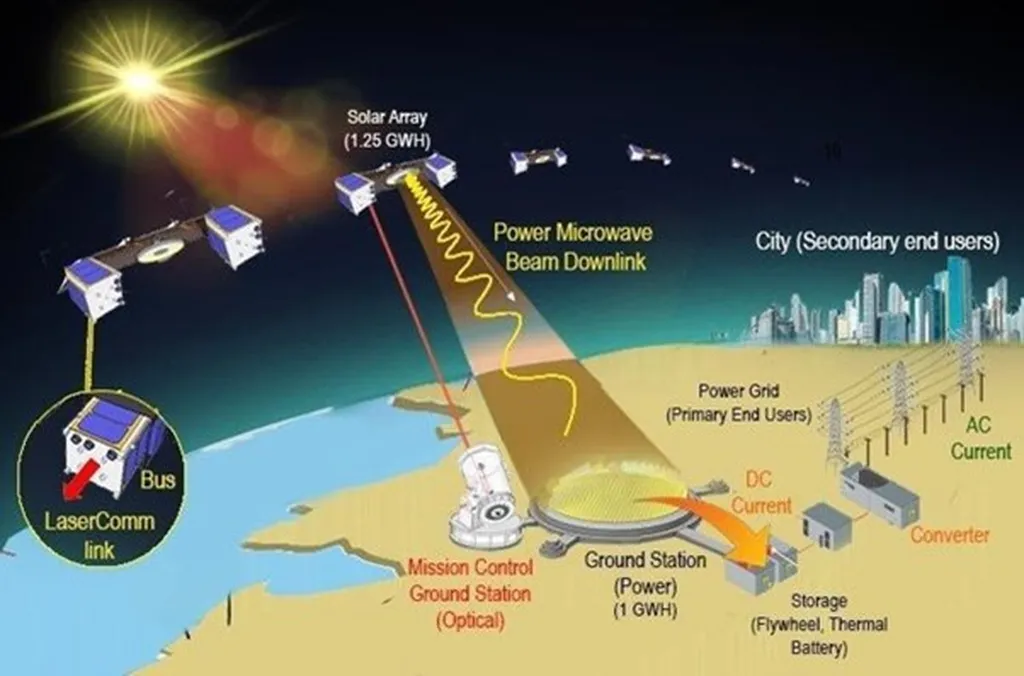
In the realm of energy and space research, a recent study by Vladimir Pletser, a researcher affiliated with the International Space University, offers intriguing insights into the dynamics of planetary and satellite systems. While his work primarily focuses on celestial mechanics, the findings could have implications for understanding the long-term stability of space-based energy infrastructure, such as satellite solar power systems.
The study, published in the journal Celestial Mechanics and Dynamical Astronomy, explores how the mean distance ratios between regular satellites in the planetary systems of Jupiter, Saturn, and Uranus evolve over time. These distance ratios, which often form near geometrical progressions, are influenced by dynamical effects beyond direct gravitational interactions. Two key factors considered in the research are primary tides and gas drag caused by primordial nebulae.
Primary tides, which are deformations in a planet caused by the gravitational pull of its moons, and gas drag from the remnants of the nebulae from which the planets formed, both play significant roles in the evolution of these distance ratios. The research derives a general relation to estimate past initial mean distance ratios and characterizes these effects for primary tides and nebular gas drag.
The findings indicate that the mean distance ratios of the four systems—Jupiter, Saturn, Uranus, and the Solar System as a whole—have not significantly evolved under primary tidal action over periods corresponding to the age of the Solar System. Additionally, the mean distance ratios remain approximately conserved after the dissipation of initial nebulae. The study also suggests that the mean distance ratios may not have changed much due to gas drag caused by primaeval nebulae after the formation of initial proto-secondaries, depending on initial nebulae models and periods of effective drag.
While this research does not imply that individual satellite distances or distance ratios are conserved, it does highlight the approximate conservation of mean distance ratios, potentially reinforced by resonances among the mean motions of the satellites. For the energy sector, particularly space-based energy projects, understanding these dynamics can be crucial for predicting the long-term stability and orbital mechanics of satellite constellations. This knowledge could inform the design and deployment of satellite solar power systems, ensuring their longevity and efficiency in harnessing solar energy from space.
This article is based on research available at arXiv.