
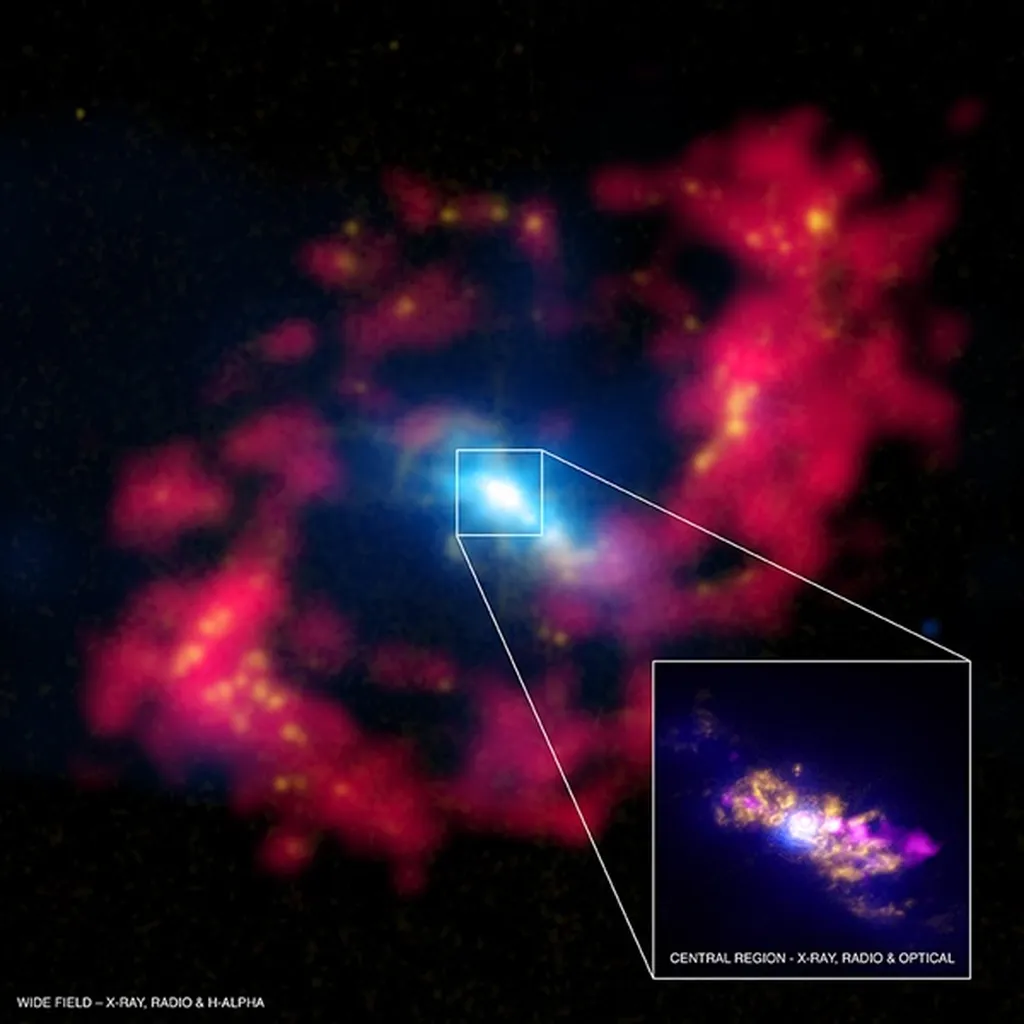
Researchers from the National Radio Astronomy Observatory, University of Maryland, and SRON Netherlands Institute for Space Research have published new findings on the magnetic field structures in the radio outflow of the Seyfert galaxy NGC 4151. Their study, titled “A Stratification in Magnetic Field Structures: The Radio Outflow in NGC 4151,” was published in the Astrophysical Journal.
The team, led by Salmoli Ghosh, used the Karl G. Jansky Very Large Array (VLA) to observe the galaxy at 3 and 10 GHz. They discovered a stratified magnetic field structure in the galaxy’s radio outflow, with fields perpendicular to the jet direction in the central ‘spine’ and parallel in the surrounding ‘sheath’. This ‘spine-sheath’-like structure was observed in the higher resolution image at 10 GHz. Additionally, a ‘wind’-like component with magnetic fields perpendicular to the radio outflow was observed in the 3 GHz image, prominent along the eastern jet direction.
The researchers also noted a range of rotation measures (RM) from -230 to 250 rad m$^{-2}$ over the polarized regions, indicating a low-electron-density medium surrounding the source causing Faraday rotation. They observed a tentative RM gradient transverse to the northern ‘wind’ component, and a similar gradient with opposite sign across the southern ‘wind’ component, suggesting a helical magnetic field threading the outflow.
Based on their analysis of the available radio and X-ray data, the researchers concluded that the stratified radio outflow in NGC 4151 is magnetically-driven. They found that the bi-conical radio ‘wind’ is massive, with a high mass outflow rate but low kinetic power, making it less impactful for galactic-scale feedback. Their study suggests that radio-quiet AGN may also host magnetically dominant jets and winds, even while their jets are smaller and weaker compared to radio-loud AGN.
This research provides valuable insights into the nature of radio outflows in radio-quiet AGN, which could have implications for our understanding of the role of magnetic fields in the energy output of these galaxies. The findings could also help inform future studies of the impact of AGN feedback on galaxy evolution.
This article is based on research available at arXiv.