
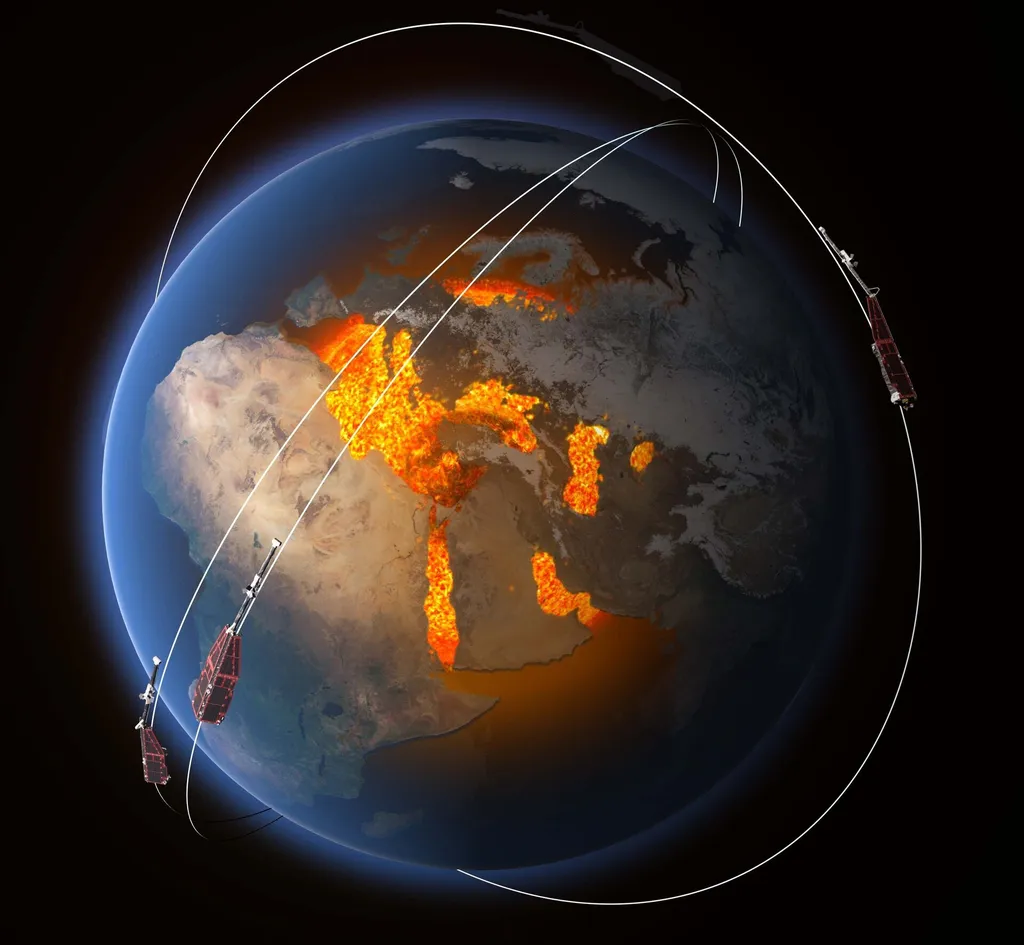
In the realm of space weather research, a team of scientists from various institutions, including the Institute for Space Astrophysics and Planetology in Italy, the British Antarctic Survey, and the University of Oslo, have collaborated to develop a novel data product that could significantly enhance our understanding of the Earth’s ionosphere. This team, led by Yaqi Jin, has utilized high-resolution plasma density data from the Swarm satellites to create a set of parameters that characterize ionospheric structures and irregularities.
The researchers have processed approximately eight years of data from the Swarm A satellite, spanning from late 2014 to the end of 2025. Their analysis reveals that the variations in plasma structures and irregularities are influenced by several factors, including solar activity, season, local time, and geomagnetic activities. Notably, the high-latitude ionosphere exhibits persistent structures and irregularities poleward of 60 magnetic latitude, while low-latitude irregularities are predominantly observed between 19:00 and 01:00 local time near the magnetic equator.
One of the key findings of this study is the seasonal variation in the occurrence of steep spectral slopes at high latitudes, which maximizes during local summer and minimizes during local winter in both hemispheres. At low latitudes, the occurrence of steep spectral slopes is only significant when substantial plasma structures and irregularities are present. The researchers have also calculated the histogram of spectral slopes at low latitudes when the rate of change of density index is enhanced, finding that it resembles a Gaussian distribution with an expected value of 1.97.
The practical applications of this research for the energy sector, particularly in space weather monitoring and forecasting, are substantial. Understanding the behavior of the ionosphere is crucial for mitigating the impacts of space weather events on power grids, satellite communications, and navigation systems. The high-resolution data product developed by this research team will be invaluable for scientists studying the magnetosphere-ionosphere-thermosphere coupling and the near-Earth space environment. This research was published in the journal Geoscientific Model Development.
This article is based on research available at arXiv.