
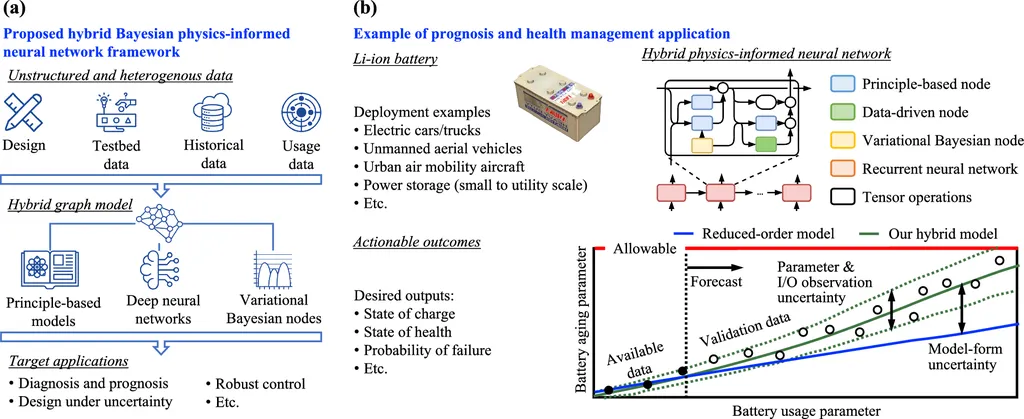
In a groundbreaking study, a team of researchers from various institutions, including the University of Glasgow, the University of Cambridge, and the University of Milan, has introduced a novel approach to physical neural networks that could significantly impact the energy sector. The team, led by Fabiana Taglietti and Jack C. Gartside, has demonstrated the potential of Kolmogorov-Arnold Network (KAN) architectures in improving the performance and efficiency of learning systems, with practical applications in predicting the dynamics of Li-Ion batteries.
Traditional physical neural networks focus on training linear synaptic weights while treating device nonlinearities as fixed. However, the researchers have shown that training the synaptic nonlinearity itself can yield markedly higher task performance per physical resource. This approach, inspired by KAN architectures, leverages reconfigurable nonlinear physical dynamics to enhance computational efficiency. The team experimentally realized physical KANs using silicon-on-insulator devices, termed ‘Synaptic Nonlinear Elements’ (SYNEs), which operate at room temperature, with currents ranging from 0.1 to 1 microamperes, and at speeds of 2 MHz. These devices exhibited no degradation over 10^13 measurements and months-long timescales, indicating their robustness and reliability.
The researchers demonstrated the effectiveness of physical KANs in various tasks, including nonlinear function regression, classification, and prediction of Li-Ion battery dynamics from noisy real-world multi-sensor data. Notably, physical KANs outperformed equivalently-parameterised software multilayer perceptron networks across all tasks, with up to two orders of magnitude fewer parameters and two orders of magnitude fewer devices than linear weight-based physical networks. These findings establish learned physical nonlinearity as a hardware-native computational primitive for compact and efficient learning systems, with SYNE devices serving as effective substrates for heterogeneous nonlinear computing.
The implications for the energy sector are significant. Accurate prediction of Li-Ion battery dynamics is crucial for optimizing battery management systems, extending battery life, and improving the overall efficiency of energy storage solutions. By leveraging the enhanced performance and efficiency of physical KANs, energy companies can develop more sophisticated and reliable battery management systems, leading to better utilization of energy storage resources and reduced operational costs.
The research was published in the journal Nature Communications, a prestigious open-access, multidisciplinary journal that covers all areas of the natural sciences. The study’s findings represent a significant advancement in the field of physical neural networks and highlight the potential of KAN architectures in addressing real-world challenges in the energy sector. As the demand for efficient and sustainable energy solutions continues to grow, innovations like physical KANs will play a crucial role in shaping the future of energy technology.
In conclusion, the work of Taglietti, Gartside, and their colleagues offers a promising new direction for the development of learning systems in the energy industry. By harnessing the power of nonlinear physical dynamics, energy companies can achieve greater computational efficiency and accuracy in predicting battery performance, ultimately leading to more effective and sustainable energy solutions.
This article is based on research available at arXiv.