
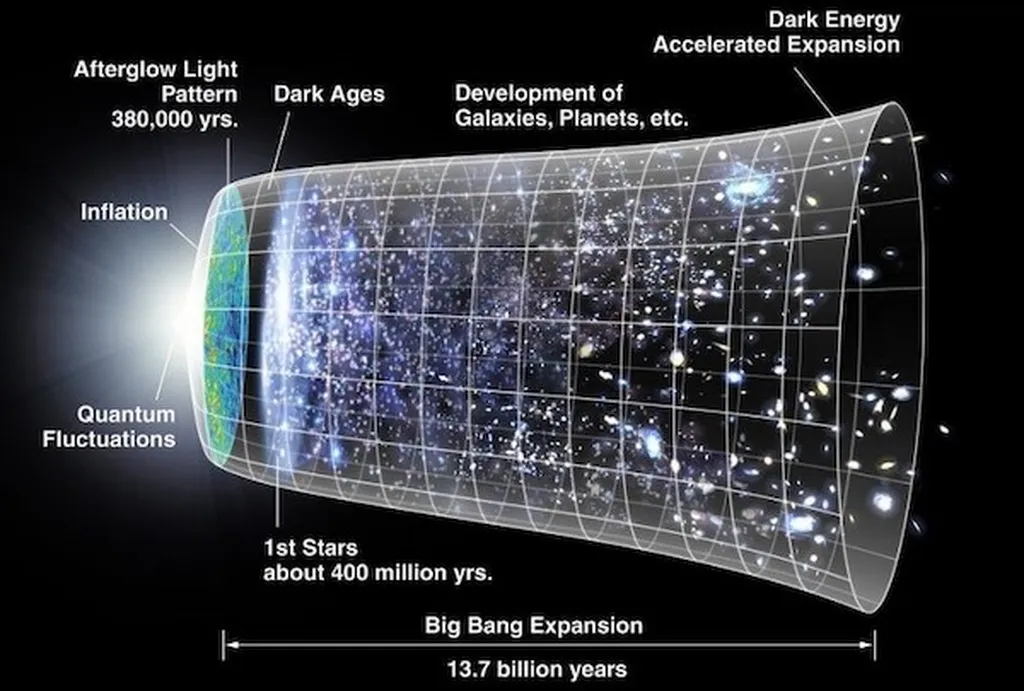
Researchers Yahia Al-Omar, Majida Nahili, and Nidal Chamoun from the Lebanese University have conducted a study that bridges early and late universe observations to test a specific type of modified gravity theory, known as f(T) gravity with nonminimal torsion-matter coupling. Their work, published in the journal Physical Review D, offers insights into the behavior of gravity across cosmic history, which could have implications for our understanding of the universe’s expansion and the nature of dark energy.
The study combines data from the early universe, specifically Big Bang Nucleosynthesis (BBN), with observations from the more recent universe, such as type Ia supernovae, baryon acoustic oscillations, and cosmic chronometers. BBN, which occurred within the first few minutes after the Big Bang, provides constraints on the fractional variation of the weak freeze-out temperature. This, in turn, limits the possible deviations from the standard expansion history of the universe. Meanwhile, the late-universe observations probe distances, the late-time standard ruler, and the Hubble rate, offering complementary insights.
The researchers examined two representative scenarios of torsion-modified gravity. They found that BBN data strongly constrains large departures from the standard cosmological model, while late-time probes remain compatible with a near-ΛCDM (Lambda Cold Dark Matter) background. This unified approach demonstrates the power of linking early-universe nuclear physics with precision cosmological observables to assess extensions of gravity that involve torsion.
For the energy sector, understanding the fundamental forces and the behavior of the universe is crucial for developing technologies that harness natural processes. While this research does not directly address energy production, it contributes to our broader understanding of the universe, which can indirectly inform the development of new energy technologies. For instance, a deeper understanding of gravity and the universe’s expansion could potentially lead to new insights into dark energy, which could have implications for energy research.
In summary, this study highlights the importance of combining different types of astronomical data to test and constrain theories of gravity. By doing so, researchers can gain a more comprehensive understanding of the universe’s evolution and the fundamental forces that govern it. This knowledge, in turn, can inform and inspire innovations in the energy sector, as scientists and engineers seek to harness the power of the natural world to meet our energy needs.
This article is based on research available at arXiv.