
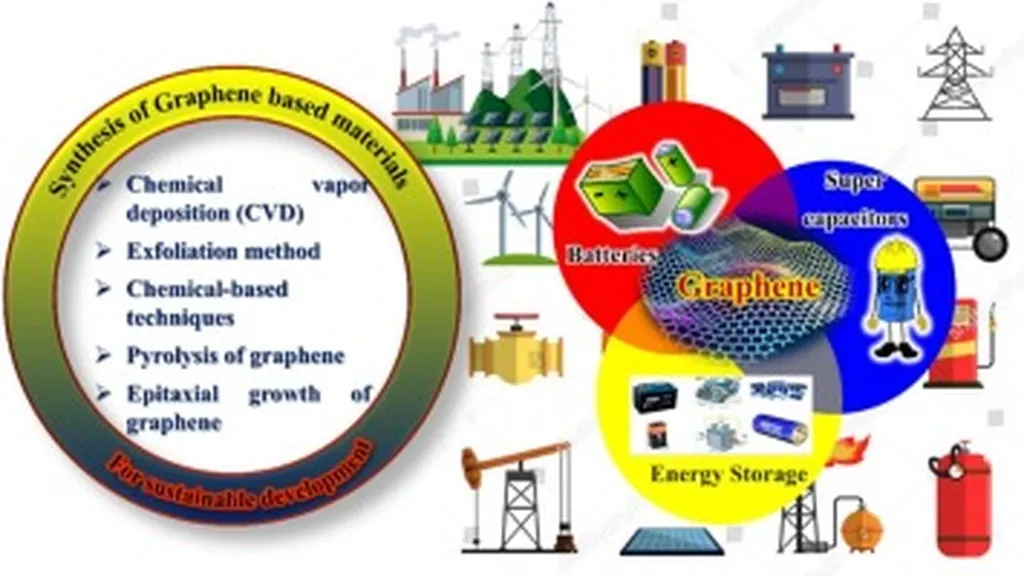
In the realm of energy technology, a team of researchers from the Graphene Flagship European project are exploring the potential of graphene and graphene-related materials (GRMs) to revolutionize various energy applications. The team, comprising Etienne Quesnel, Frédéric Roux, Fabrice Emieux, Pascal Faucherand, Emmanuel Kymakis, and others, are affiliated with institutions across Europe and the United States, including the University of Cambridge, the Italian Institute of Technology, and the University of Texas at Dallas.
The researchers are investigating the integration of graphene and GRMs into energy devices, focusing on creating composite materials that combine graphene with metal or semiconducting nanocrystals, or other carbon nanostructures like carbon nanotubes (CNT) and graphite. These composites show promise in several areas, including hydrogen storage, solar cell absorbers, and electrodes for fuel cells, batteries, and supercapacitors.
For photovoltaic (PV) electrodes, where thin layers and interface engineering are crucial, the team is employing conventional vacuum processes and innovative laser irradiation strategies to integrate graphene. The research highlights the potential of these technologies to maximize the benefits of GRM integration, with experimental and modeling results demonstrating their effectiveness.
However, the team also acknowledges the technical challenges that still need to be addressed. These include optimizing the performance and durability of the graphene-based materials in real-world energy applications. The researchers emphasize the need for continued work in this area, with perspectives derived from ongoing research offering hope for future breakthroughs.
The research was published in the journal Energy & Environmental Science, providing a comprehensive overview of the current state of graphene-based technologies for energy applications and the challenges that lie ahead. As the energy industry seeks innovative solutions to meet the growing demand for clean and sustainable energy, the work of these researchers offers a promising avenue for exploration.
This article is based on research available at arXiv.