
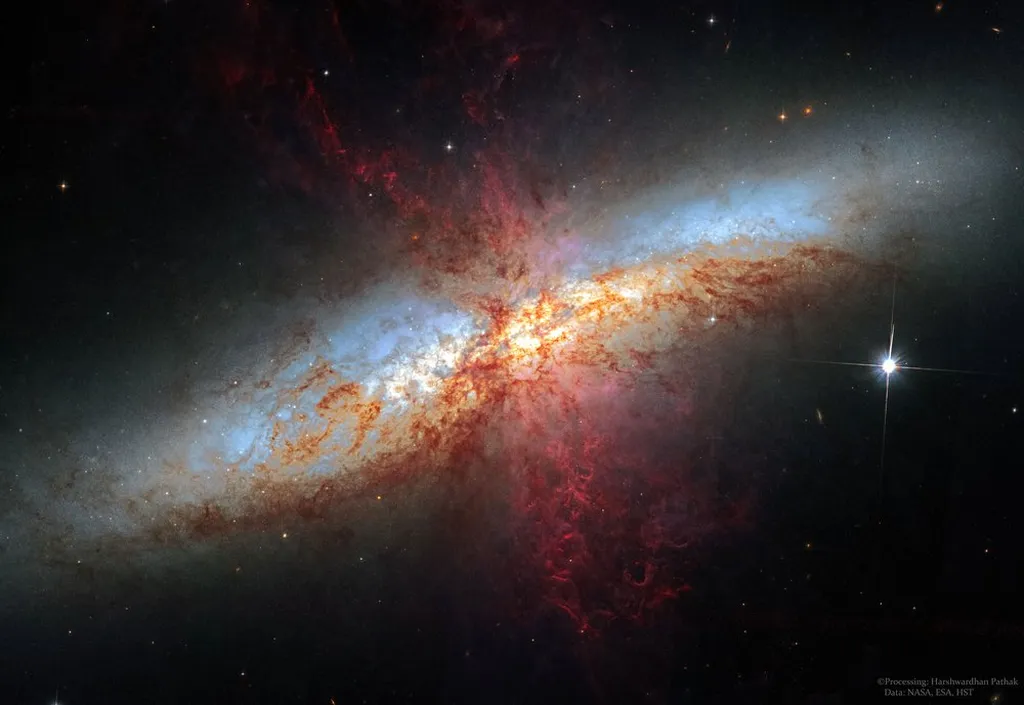
In a recent study, a team of researchers led by Maura Kathleen Shea from the Department of Physics and Astronomy at the University of Kentucky has delved into the intricate interactions between active galactic nuclei (AGN) and nearby galaxies within compact galaxy groups. Their work, published in the Astrophysical Journal, focuses on Stephan’s Quintet, a nearby compact group of galaxies, and provides valuable insights into the dynamics of AGN feedback, which can have significant implications for the energy sector.
The researchers utilized the James Webb Space Telescope (JWST) and the Kitt Peak Ohio State Multi-Object Spectrograph to obtain spatially-resolved long-slit spectra of Stephan’s Quintet. By fitting multiple Gaussians to the Hα and [N II] emission lines, they were able to isolate different kinematic components within the galaxy group. This allowed them to develop the first biconical outflow model of the narrow-line region of NGC 7319, one of the galaxies in Stephan’s Quintet.
Their analysis revealed outflow radial velocities of up to 550 km/s, peaking at a distance of 2.6 kiloparsecs from the central supermassive black hole. Interestingly, they found a transition from AGN-powered outflows to gravitationally-powered tidal flows at a projected distance between 2.4 and 6.3 kiloparsecs. This transition was further supported by a line ratio analysis, which showed Seyfert-like ionization out to 6.3 kiloparsecs, indicating that gas outside this radius is predominantly powered by tidal flows.
The practical applications of this research for the energy sector lie in understanding the dynamics of AGN feedback, which can influence the evolution of galaxies and their environments. This knowledge can help energy companies involved in space exploration and satellite technology to better predict and mitigate the effects of cosmic radiation and other space-related phenomena. Additionally, the study of AGN feedback can contribute to the development of more accurate models of the universe, which can be used to optimize the performance of energy systems on Earth and in space.
In summary, the research conducted by Maura Kathleen Shea and her team provides valuable insights into the dynamics of AGN feedback within compact galaxy groups. Their findings have significant implications for the energy sector, particularly in the areas of space exploration and satellite technology. The study was published in the Astrophysical Journal, a reputable source for astrophysics research.
This article is based on research available at arXiv.