
In the realm of energy journalism, it’s crucial to stay abreast of scientific research that could potentially impact the energy sector. A recent study, led by Mikhail M. Ivanov and colleagues from the University of California, Berkeley, and other institutions, has delved into the intricacies of cosmological parameters and their implications. The research, published in the journal Physical Review D, offers insights that could indirectly influence energy technologies, particularly those related to space exploration and satellite technology.
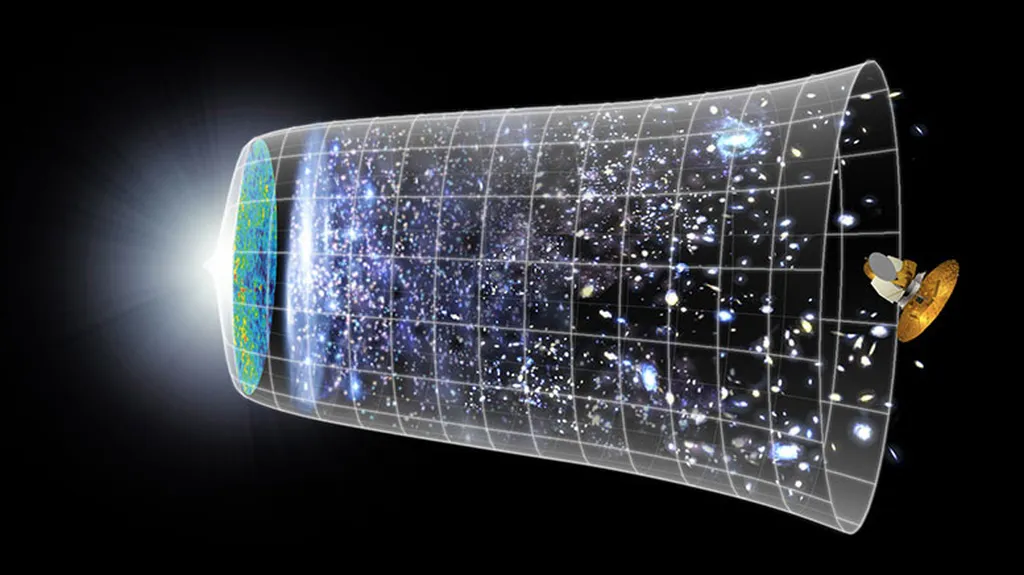
The team of researchers, including James M. Sullivan, Shi-Fan Chen, Anton Chudaykin, Mark Maus, and Oliver H. E. Philcox, has reanalyzed data from the Dark Energy Spectroscopic Instrument (DESI) Data Release 1. By combining various datasets and employing advanced theoretical computations, they have achieved significant improvements in constraining cosmological parameters. These parameters include the Hubble constant, which measures the rate of expansion of the universe, and the matter density fraction, which indicates the proportion of matter in the universe.
The study’s findings are notable for their precision. The researchers have determined the Hubble constant with a precision of 0.6%, the matter density fraction with a precision of 1.7%, and the mass fluctuation amplitude with a precision of 2%. These measurements are crucial for understanding the fundamental properties of the universe and could have implications for technologies that rely on space-based observations, such as satellite communications and energy systems.
One of the most intriguing aspects of the research is its exploration of dark energy models. The team found a preference for a dynamical dark energy model over a static one, based on low-redshift data. This preference was further strengthened when combining the data with cosmic microwave background (CMB) information. The study also improved the dark energy figure-of-merit by 18%, which is a measure of how well a model can distinguish between different dark energy scenarios.
The research also placed strong bounds on the sum of the neutrino masses, improving upon previous constraints by 25%. This is significant because neutrinos, while not directly related to energy production, play a role in various astrophysical processes that could indirectly impact energy technologies.
In summary, the study by Ivanov and colleagues provides a robust analysis of cosmological parameters and their implications for dark energy models. The findings could have practical applications in the energy sector, particularly in technologies that rely on space-based observations and measurements. As we continue to explore the universe, understanding its fundamental properties will be crucial for developing new energy technologies and improving existing ones. The research was published in Physical Review D, a leading journal in the field of particle physics, gravitation, and cosmology.
This article is based on research available at arXiv.