
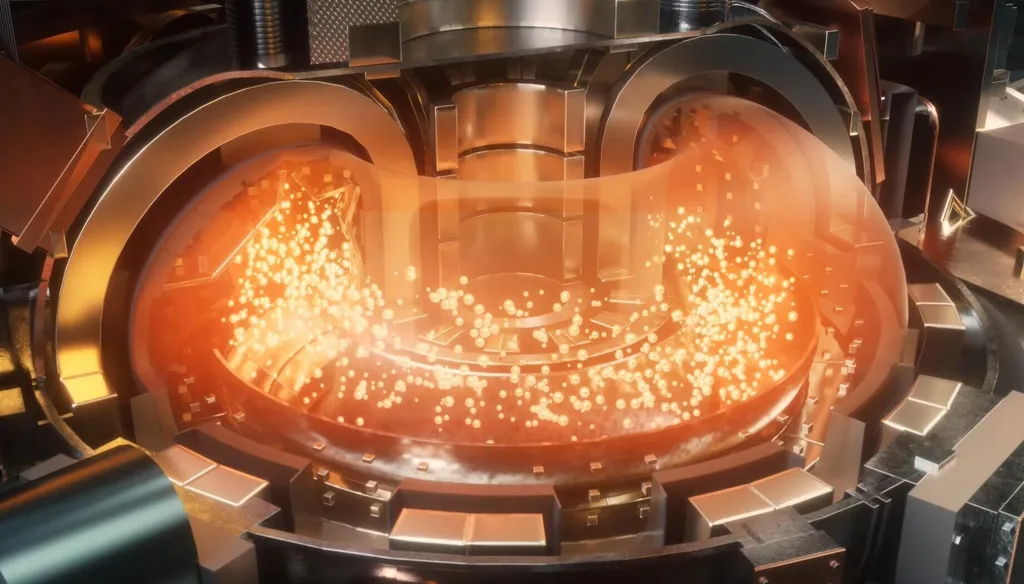
Researchers from the Southwest Jiaotong University and the Chinese Academy of Sciences, led by L. W. Hu and W. Chen, have conducted experiments on the HL-2A tokamak to investigate the density limit and core-localized kinetic magnetohydrodynamic (MHD) instabilities in Ohmic heating plasmas. Their findings, published in the journal Nuclear Fusion, offer new insights into the challenges of magnetic confinement nuclear fusion, which is a key technology for future fusion power plants.
The density limit is a well-known but poorly understood barrier in fusion research, beyond which plasma confinement is lost, and disruptions occur. The team achieved high-density plasmas with a density ratio (ne/ne_G) greater than 1 using conventional gas-puff fueling methods. These high-density states lasted for approximately 500 milliseconds, which is about 30 times the global energy confinement time (τ_E). This extended duration provides a valuable window for studying the behavior of plasmas at high densities.
The researchers also observed, for the first time, core-localized kinetic MHD instabilities when the density ratio approached 1. These instabilities are believed to be either Alfvénic ion temperature gradient (AITG) modes or kinetic ballooning modes (KBM). Importantly, these core-localized activities were found to trigger minor or major disruptions in the bulk plasma when the density profile was peaked. This discovery is significant because it sheds light on the mechanisms underlying the density limit and could help in developing strategies to avoid or mitigate disruptions in future fusion reactors.
For the energy industry, understanding and overcoming the density limit is crucial for the practical implementation of magnetic confinement fusion. Fusion power plants, such as those based on tokamak designs, aim to harness the same process that powers the sun to generate clean, abundant energy. By addressing the density limit, researchers can improve plasma confinement and stability, bringing us closer to realizing fusion energy as a viable and sustainable energy source. The findings from this research contribute to the ongoing efforts to optimize plasma conditions and enhance the performance of fusion devices, ultimately accelerating the development of fusion energy technology.
Source: Hu, L. W., et al. “Density Limit Experiments and Core-localized Kinetic MHD Activities in HL-2A Ohmic Heating Plasmas.” Nuclear Fusion, 2023.
This article is based on research available at arXiv.