
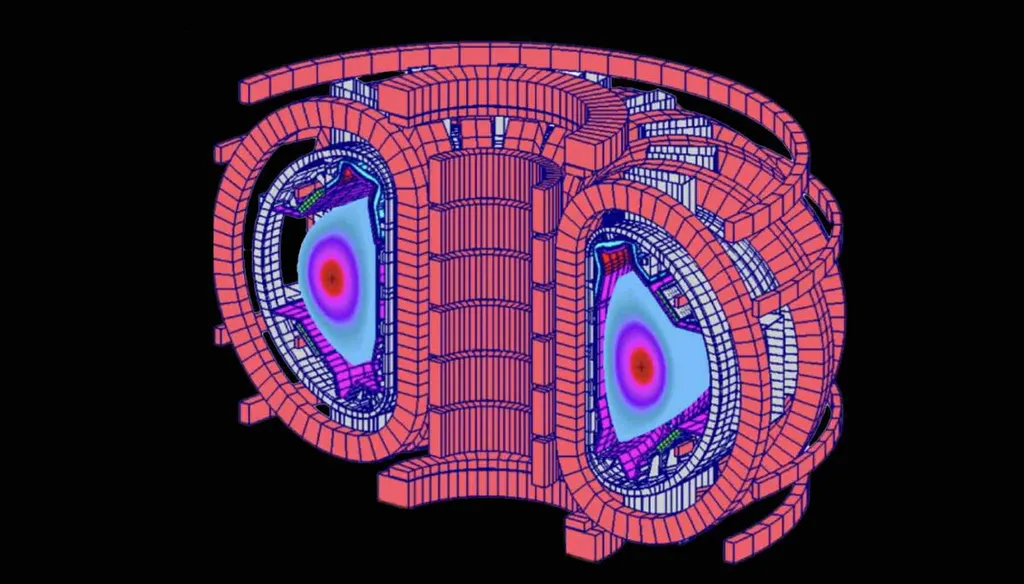
In the realm of nuclear fusion research, a team of scientists from the Southwest Jiaotong University and the Chinese Academy of Sciences, led by Wei Chen, has made a significant stride in understanding a longstanding challenge in tokamak plasmas. Their findings, published in the journal Physical Review Letters, shed light on the mysterious density limit disruption that has hindered the progress of magnetic confinement nuclear fusion.
The researchers conducted high-density experiments on the HL-2A tokamak, pushing the plasma density close to the Greenwald density limit, a critical threshold beyond which disruptions often occur. They observed, for the first time, multiple-branch magnetohydrodynamic (MHD) instabilities in the core plasma when the density ratio exceeded 0.85. These instabilities were identified as Alfvénic ion temperature gradient (AITG) modes through simulation analysis.
The team discovered that these core-localized AITG modes can trigger minor or major disruptions in the bulk plasma when the density profile is peaked. This finding is crucial as it provides a new perspective on the origin of density limit disruptions, a phenomenon that has been an unresolved issue in the field of nuclear fusion.
The practical implications of this research are significant for the energy sector, particularly for the development of future fusion reactors. Understanding and predicting these disruptions can help in designing more stable and efficient tokamak plasmas, bringing us closer to achieving a high energy gain in fusion reactions. This could potentially revolutionize the energy industry by providing a clean, sustainable, and virtually limitless source of power.
The research conducted by Wei Chen and his team marks a significant step forward in the quest for practical nuclear fusion. Their findings not only advance our understanding of plasma physics but also pave the way for more stable and efficient fusion reactors, a prospect that holds immense promise for the future of energy production.
This article is based on research available at arXiv.